Independent Pet Shop Near Me: How Small Retailers Rank for Local Long-Tail Keywords


Table of Contents +
- Why Can't Independent Pet Shops Rank for 'Pet Shop Near Me'?
- What Are Local Long-Tail Keywords?
- Four Types of Local Long-Tail Keywords Pet Shops Can Target
- How Do You Find Local Keywords You Can Actually Rank For?
- How Should You Optimise Content for Local Long-Tail Keywords?
- How Do Topical Clusters Amplify Local Rankings?
- From Keyword List to Published Content: Your Launch Roadmap
- Frequently asked questions
- References
Searching 'independent pet shop near me' favours big chains. Here's how small retailers rank for local long-tail keywords and win nearby buyers.
It's a wet Tuesday evening in Bristol. Someone three streets from your shop picks up their phone, thumbs in independent pet shop near me, and hits search - they want grain-free food for a fussy French Bulldog, and they want it tonight. Your shelves have exactly what they need. Yet the results they scroll are a wall of national chains, a directory listing, and a map pin that isn't yours.
That shopper walks to whoever showed up first. Multiply that by every high-intent search in your town, every week, and you can watch the revenue leaking past your door to competitors with deeper pockets and older domains. The good news: the broad term isn't where you win anyway - and the queries that actually convert are wide open.
Why Can't Independent Pet Shops Rank for 'Pet Shop Near Me'?
Independent pet shops struggle to rank for broad terms like 'pet shop near me' because national chains and marketplaces hold domain authority small retailers can't match. The winnable ground is local long-tail: specific product, breed, or condition searches paired with a place name, where competition thins and buyer intent runs high.
Search the head term yourself and you'll see the problem. The first page belongs to national chains and directory aggregators whose domains have accumulated authority over many years - the kind of ratings independent retailers simply can't out-muscle with realistic effort. Research on SEO for small and medium enterprises confirms that competing head-on for these high-domain authority terms is a losing strategy for smaller players.
Local long-tail keywords flip the maths. Instead of fighting for 'pet shop near me', you target 'grain-free puppy food in Bristol' or 'raw dog food delivery Leeds' - phrases with fewer competitors and shoppers who already know what they want. This is a modifier layer on top of ordinary long-tail strategy, which our complete guide to long-tail keyword examples sets out in full.
It also loosens your dependence on Amazon and zooplus. Leaning entirely on marketplace listings leaves you with no indexed, ranking content on your own domain and no control over pricing or visibility; building organic search independence on your own site is what keeps customer acquisition in your hands.
Petbase automates SEO content for pet stores - publishing 10 optimized articles monthly so you can focus on running your shop - start your free trial.
What Are Local Long-Tail Keywords?
Local long-tail keywords are specific, multi-word searches that pair a clear need - a product, breed, or health condition - with a location. They differ from the navigational query 'pet shop near me' by carrying explicit purchase intent. What defines them is specificity and low competition, not vague reach or raw search volume.
Think of the difference between someone typing 'best pet shop near me' - just browsing for options - and someone typing 'organic grain-free dog food in Bristol'. The first is navigational and broad; the second names a product, a diet, and a place. That precision is the whole point. These queries typically sit between 50 and 1,000 monthly searches each, and they attract buyers who are close to a decision.
That decisiveness shows up in the numbers. High-intent long-tail queries convert at roughly 8-15%, compared with 1-5% for broad head terms. A shopper searching for a named diet in a named town has already done their comparison; they're looking for a shop that stocks it, not an education.
Four Types of Local Long-Tail Keywords Pet Shops Can Target
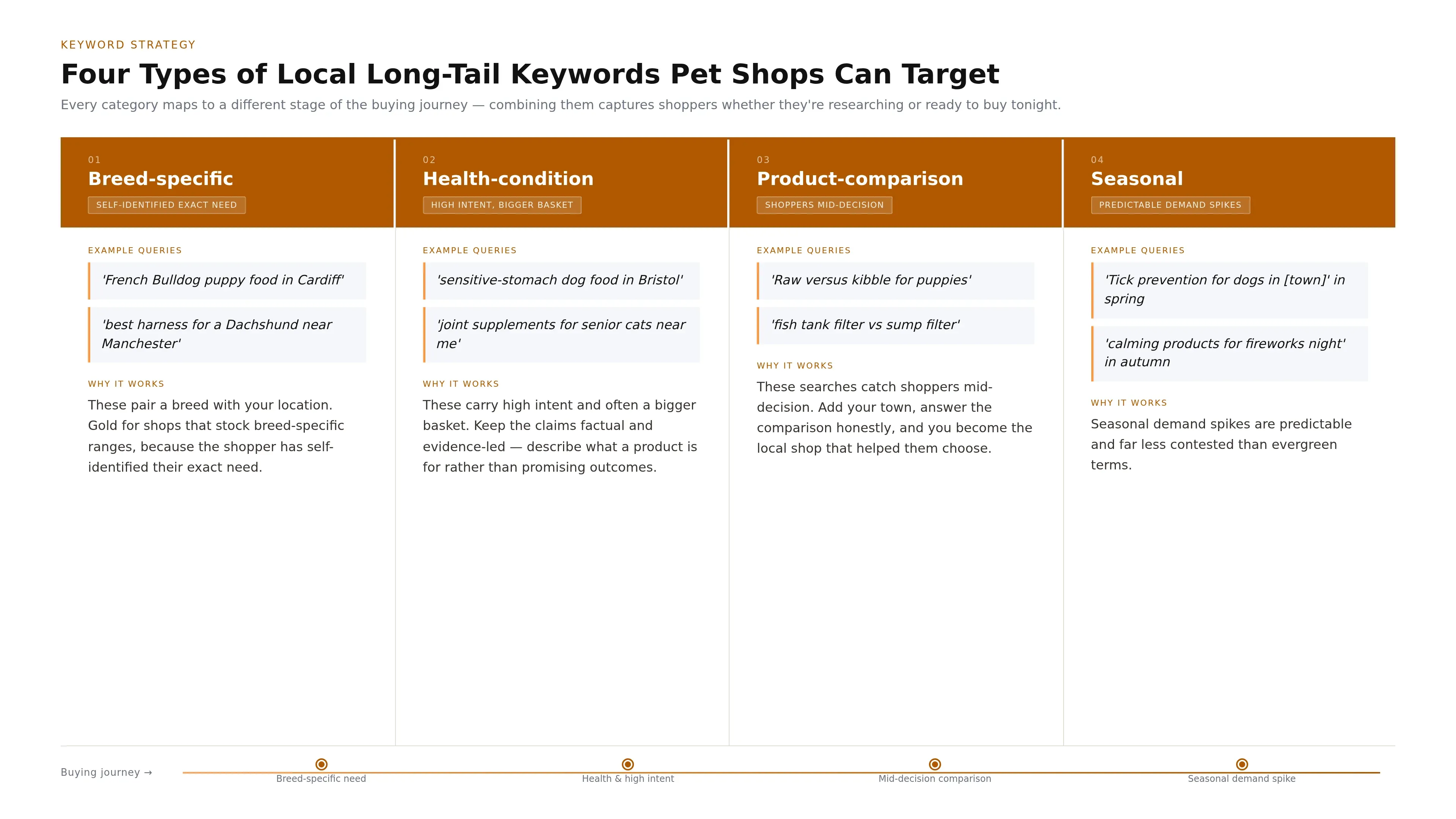
Independent pet shops can target four categories of local long-tail keyword: breed-specific, health-condition, product-comparison, and seasonal - each paired with a location. Every category maps to a different stage of the buying journey, so combining them across your content captures shoppers whether they're researching or ready to buy tonight.
The four categories below all descend from the query types that drive pet e-commerce, with a place name bolted on. Local modifiers are one of the core long-tail categories in pet search, and they combine cleanly with the other three.
Breed-specific local keywords
These pair a breed with your location: 'French Bulldog puppy food in Cardiff' or 'best harness for a Dachshund near Manchester'. They're gold for shops that stock breed-specific ranges, because the shopper has self-identified their exact need.
Health-condition local keywords
Searches like 'sensitive-stomach dog food in Bristol' or 'joint supplements for senior cats near me' carry high intent and often a bigger basket. Keep the claims factual and evidence-led - pet-health content sits under heightened scrutiny, so describe what a product is for rather than promising outcomes.
Product-comparison local keywords
'Raw versus kibble for puppies' or 'fish tank filter vs sump filter' searches catch shoppers mid-decision. Add your town, answer the comparison honestly, and you become the local shop that helped them choose.
Seasonal local keywords
'Tick prevention for dogs in [town]' in spring, 'calming products for fireworks night' in autumn - seasonal demand spikes are predictable and far less contested than evergreen terms.
How Do You Find Local Keywords You Can Actually Rank For?
To find rankable local long-tail keywords, start with keyword-difficulty scores in the 20-45 range, validate search volume against your product's price point, then map the competitive landscape for your specific town. This combination surfaces phrases with genuine demand that your domain can realistically reach within a few months.
Begin with difficulty. For a newer site, target keyword-difficulty scores of 0-30 and graduate toward 20-35 as your topical authority grows. The 20-45 difficulty band is the sweet spot for independent retailers: competitive enough to signal real demand, low enough to rank within two to six months with a single well-optimised article.
Then validate volume against value. Around 50 monthly searches is a sensible floor for a page that has to stand on its own, while 100-200 gives more predictable traffic. But a lower-volume phrase can still earn its own page when it points at a premium product - 20 searches a month for a £150 order is worth chasing in a way the same volume for a £5 commodity isn't.
Finally, read the local SERP. Search your target phrase, note who ranks, and gauge whether they're beatable directory listings or entrenched chains. This is the same low-competition discovery workflow we walk through step by step in our guide to finding low-competition keywords for your pet store.
How Should You Optimise Content for Local Long-Tail Keywords?
Optimise each local long-tail page by putting the full keyword - product plus location - in the title, H1, and meta description, then structuring the body around that specific need and place. Add genuine local detail, and link internally with exact-match or close-variant anchor text to related pages.
Start with the on-page basics. If your target is 'grain-free dog food in Bristol', that phrase - or a close variant - belongs in the page title, the H1, the meta description, and the opening paragraph. Write naturally; you're signalling relevance to Google and reassuring the reader they've landed in the right place, not stuffing a keyword.

Then earn the 'local' part. Reference the neighbourhoods you deliver to, mention that you stock the brand in-store today, note collection times. Generic content with a town name pasted in fools no one; specific, lived-in local detail is what separates a page that ranks from one that reads like filler.
This is precisely the kind of structured, EEAT-aligned page the Petbase AI platform builds automatically for pet retailers, with schema markup and internal links embedded at publication rather than bolted on afterwards.
How Do Topical Clusters Amplify Local Rankings?
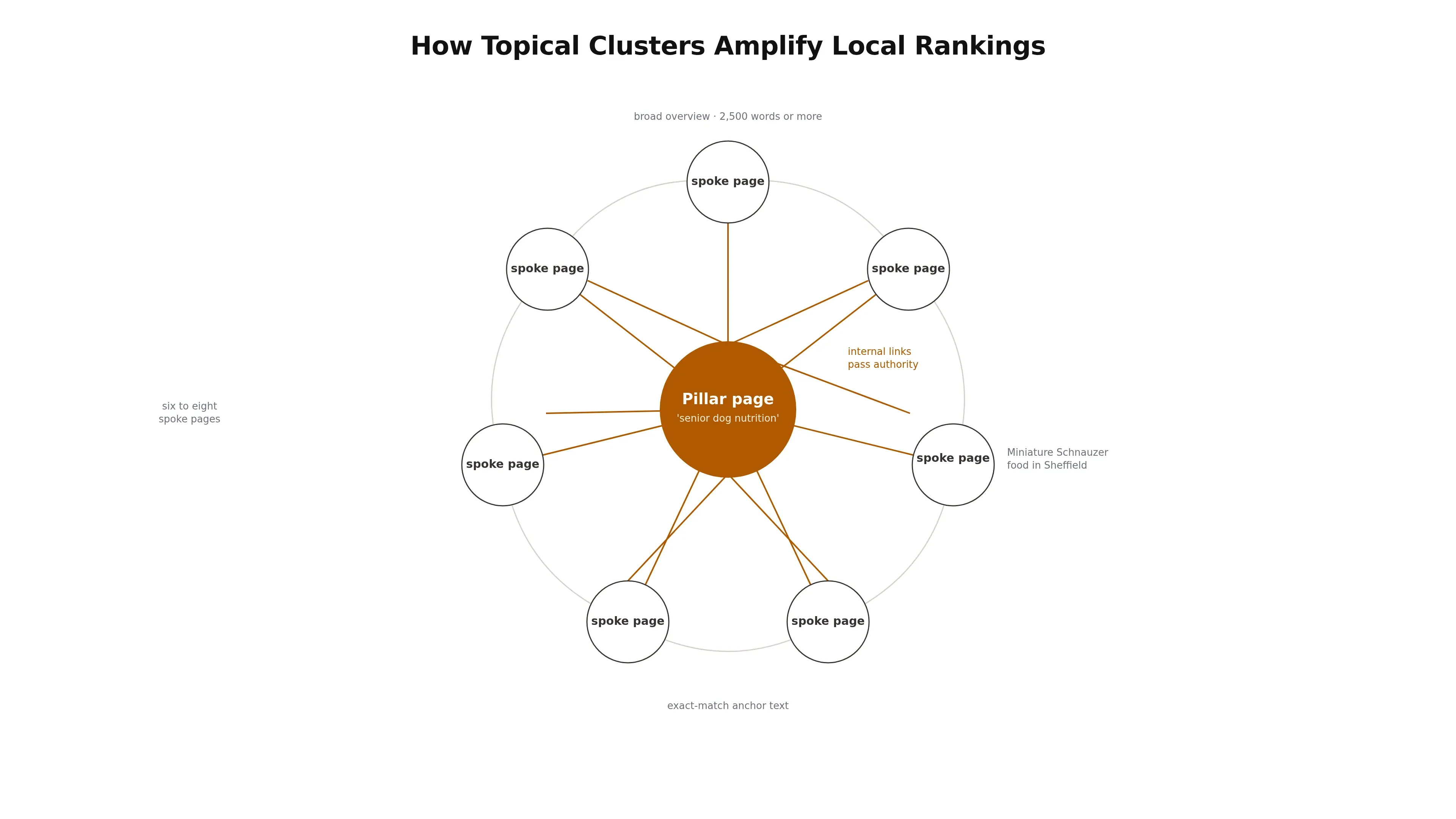
Topical clusters amplify local rankings by grouping a broad pillar page with several location-specific spokes, all cross-linked. The pillar targets the head topic while spokes capture individual local long-tail queries, and internal links pass authority between them - so the whole cluster ranks faster and holds position more steadily than isolated pages.
A cluster is one pillar page - a broad overview such as 'senior dog nutrition', 2,500 words or more - supported by six to eight spoke pages, each targeting a single local long-tail variant. The spokes link up to the pillar and across to two or three siblings using exact-match or close-variant anchor text. To Google, that structure demonstrates genuine topical depth.
The payoff is durability. Sites with a hundred or more interlinked articles covering a niche see their rankings persist around 2.5 times longer than isolated pages. When you organise local keywords for pet stores into clusters, a dip on one page is cushioned by the authority flowing from its siblings - protection an orphaned blog post never gets.
This is where volume stops mattering in isolation. A spoke targeting 30 monthly searches for 'Miniature Schnauzer food in Sheffield' might not justify a standalone page, but inside a cluster it inherits authority from the pillar and every sibling, pulling its weight as part of the whole.
From Keyword List to Published Content: Your Launch Roadmap
Turn your keyword list into rankings by publishing in cluster order - pillar first, then spokes - tracking each local keyword's position weekly, and attributing organic traffic to the pages driving it. Expect first-page movement in roughly six to eight weeks, then scale into new locations and categories.
Publish in a deliberate order: the pillar first to anchor the topic, then the spokes over the following weeks so internal links have something to point to. High-intent local long-tail pages typically start showing first-page movement within six to eight weeks - quicker in less contested markets, slower where chains have dug in.
Track ruthlessly. Monitor each target keyword's position, watch which pages pull organic sessions, and attribute traffic to the specific spokes doing the work. That data tells you which categories to expand and which locations to add next - the practical steps for how to rank your pet shop locally live on our long-tail keyword launch checklist.
Then scale. Once a cluster proves itself, replicate the pattern for the next town, the next breed, the next condition. Consistency is the constraint here, not cleverness - and it's the part most independent retailers struggle to sustain by hand.
The shopper searching for an independent pet shop near me isn't lost to the chains - they're lost to whoever ranks for the specific, local, high-intent query they actually type. Broad terms belong to the big domains; the winnable ground is the long-tail combination of product, condition, breed, and place, organised into clusters that compound over time.
None of it is complicated. It is, however, relentless - the discovery, the writing, the internal linking, the publishing cadence, repeated across dozens of keywords and locations. That's the part worth automating.
Frequently asked questions
How long does it take to rank for local long-tail keywords?
High-intent local long-tail pages typically reach the first page within six to eight weeks, and often faster in less competitive markets. Timelines stretch where national chains are entrenched. Ranking speed improves once you build topical clusters, because internal links pass authority between pages and help the whole group climb together rather than each page fighting alone.
What's the difference between 'pet shop near me' and a local long-tail keyword?
'Pet shop near me' is a broad, navigational search dominated by national chains and directories. A local long-tail keyword adds specificity - a product, breed, or health condition tied to a location, such as 'grain-free puppy food in Bristol'. That precision means less competition and far higher purchase intent, which is exactly why independent shops can rank for it.
Which local long-tail keywords should an independent pet shop start with?
Start with keyword-difficulty scores between 0 and 30 while your domain is new, then move toward the 20-45 sweet spot as your authority grows. Prioritise phrases that combine a specific product, breed, or condition with your town and clearly point toward a purchase. Validate that the demand is real, then build them into a cluster rather than publishing them as isolated pages.
Do I need a separate page for every local keyword?
Not always. A keyword with strong demand and clear intent earns its own optimised page, especially when it points at a higher-value product. Lower-demand phrases work best as spokes inside a topical cluster, where internal links from the pillar and sibling articles transfer authority. The cluster lets you cover many local variations without every one carrying a page alone.