Long Tail Keyword Examples: Complete Guide for Independent Pet Retailers


Table of Contents +
- Why can't independent pet retailers win on generic keywords?
- What are long-tail keywords?
- Which four query categories drive pet e-commerce intent?
- Why do long-tail keywords convert better?
- Building authority through topical clusters
- The keyword difficulty sweet spot
- Long-tail keyword examples across pet categories
- How do you turn keywords into a content strategy?
- Frequently Asked Questions
- Sources and Further Reading
See long tail keyword examples for pet shops across dog, cat and aquatic niches - and how independent retailers use them to outrank the big chains.
If your pet shop's blog posts and product pages aren't pulling in organic traffic, it's tempting to conclude the content simply isn't good enough. That's rarely the real problem. The problem is where you're competing: terms like "dog food" and "pet supplies" are already owned by chains and marketplaces with a decade's head start, and no amount of polish will dislodge them.
Reframe the goal, and the picture changes. The traffic you're missing lives in the specific, lower-competition searches your customers actually type - and the long tail keywords examples in this guide show exactly what those look like. Keep chasing head terms and you'll pour months of effort into pages that never reach page one; target the long tail instead, and you compete on ground where a small store can genuinely win.
Why can't independent pet retailers win on generic keywords?
Independent pet retailers can't win on generic keywords because head terms like "dog food" are dominated by large chains and marketplaces with domain authority built over years. Competing there is a losing game. Your realistic route to page one is the long tail - specific queries the giants overlook and you can actually rank for.
The visibility gap: marketplaces versus your own domain
Many independent stores lean on Amazon and zooplus listings for sales, which leaves their own website without indexed, ranking content. That's a structural trap: every sale routed through a marketplace builds the marketplace's authority, not yours, and keeps you dependent on a platform that controls your margin and your visibility.
Meanwhile the head terms are locked up. Chains and marketplaces carry domain ratings above 70 - Fressnapf.de sits at 74, zooplus.de at 75 - and that accumulated authority is exactly why independent retailers cannot realistically compete on head terms within any sensible timeframe. Long-tail queries are the only viable path to a page-one ranking within six months.
The encouraging part is that the long tail isn't a niche corner of search. Roughly 70% of all search volume flows through long-tail queries, so targeting them gives you access to the majority of real demand rather than the scraps. If you're still weighing this against a head-term push, our breakdown of long-tail keywords versus head terms makes the trade-off concrete.
Petbase automates SEO content for pet stores - publishing 10 optimized articles monthly so you can focus on running your shop - start your free trial.
What are long-tail keywords?
Long-tail keywords are specific, high-intent search queries - typically 50 to 1,000 monthly searches - defined by how precisely they match a buyer's need, not by how many words they contain. "Grain-free dog food for sensitive stomachs" is long-tail; "dog food" is a head term with broad, undecided intent.
Specificity and volume, not length
What makes a keyword long-tail is the specificity of its intent and its search volume. The definition rests on specificity and competition level: a single-word query with 60 monthly searches is long-tail, while a five-word query pulling 100,000 monthly searches is a head term. The number of words is a rough signal, nothing more.
In pet e-commerce, long-tail phrases cluster around clear needs: a breed ("best food for French Bulldog puppies"), a health condition ("grain-free dog food for sensitive stomachs"), or a product comparison ("fish tank filter vs sump filter"). Each names something concrete the shopper wants. Learning how to identify long-tail keywords you can actually rank for is its own skill - our guide to finding low-competition keywords for your pet store covers the discovery method step by step.
Which four query categories drive pet e-commerce intent?
Four query categories drive pet e-commerce intent: breed-specific searches, health-condition searches, product-comparison phrases, and local modifiers. Each maps to a different stage of the buyer's journey, from early research to ready-to-buy, and each needs slightly different content to capture the shopper searching it.
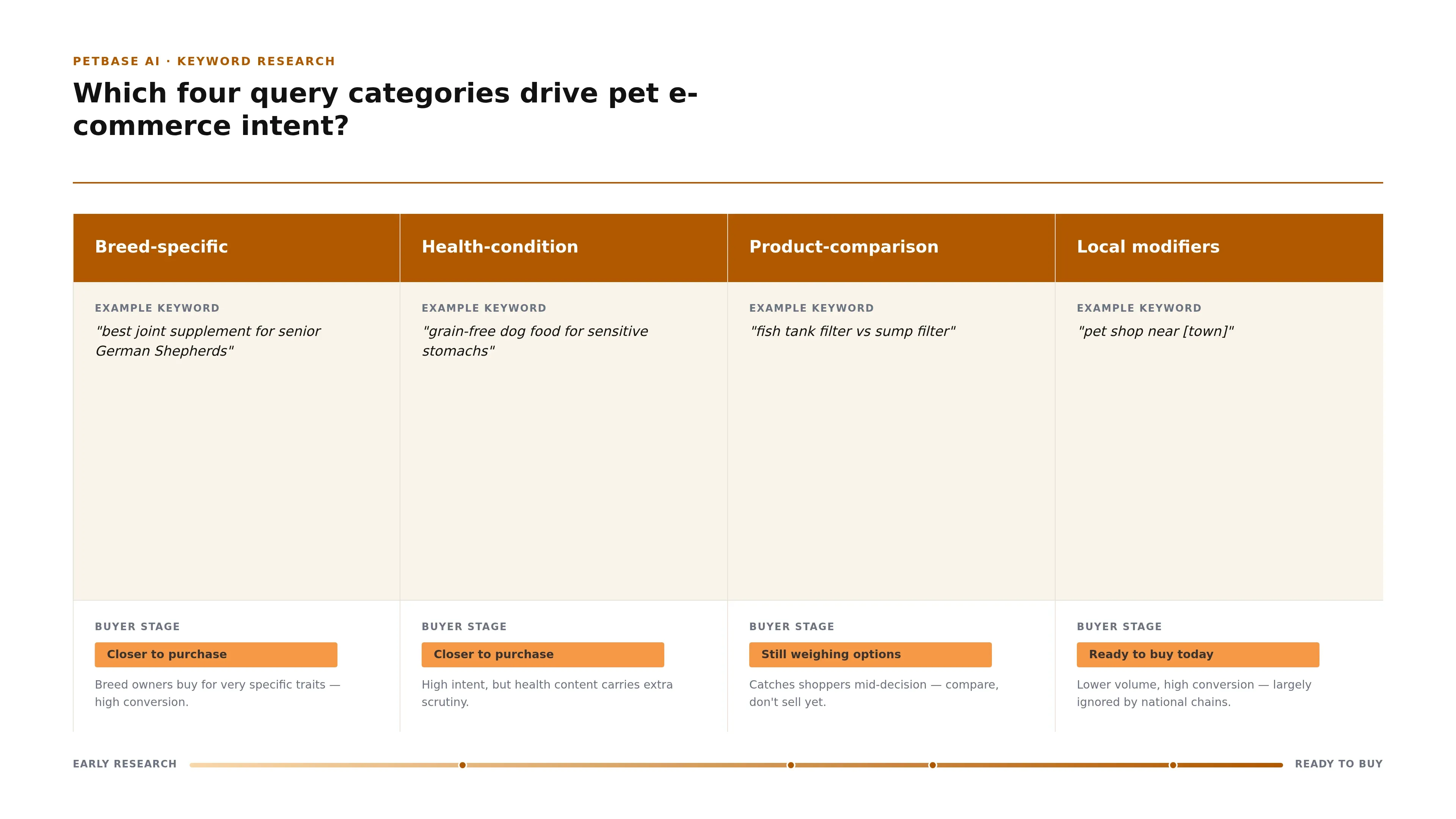
These four buckets give you a repeatable structure for keyword research. Rather than brainstorming at random, you work each category against your product range. The four query categories driving pet e-commerce intent break down like this:
- Breed-specific: "best joint supplement for senior German Shepherds", "grooming brush for long-haired cats", "harness for French Bulldogs". These convert well because breed owners buy for very specific traits - our look at why breed-specific keywords outperform generic pet searches goes deeper.
- Health-condition: "grain-free dog food for sensitive stomachs", "sensitive skin cat food", "tick prevention for cats". High intent, but health content carries extra scrutiny - see our guide to health-condition keywords and EEAT.
- Product-comparison: "fish tank filter vs sump filter", "wet vs dry food for kittens", "clumping vs non-clumping cat litter". These catch shoppers mid-decision.
- Local modifiers: "pet shop near [town]", "dog food delivery [city]". Lower volume, high conversion, and largely ignored by the national chains.
How categories map to the buyer's journey
Comparison and informational queries tend to sit earlier - the shopper is still weighing options. Breed-specific and health-condition queries with a product qualifier ("best... for...") sit closer to purchase. Local modifiers often signal someone ready to buy today. Mapping each keyword to a stage tells you whether the page should educate, compare, or sell.
Why do long-tail keywords convert better?
Long-tail keywords convert better because they capture shoppers who have already decided what they need. They convert at 8 to 15% versus 1 to 5% for broad head terms like "dog food". Someone searching "best sensitive-stomach food for Miniature Schnauzers" is ready to buy; someone typing "dog food" is only browsing.
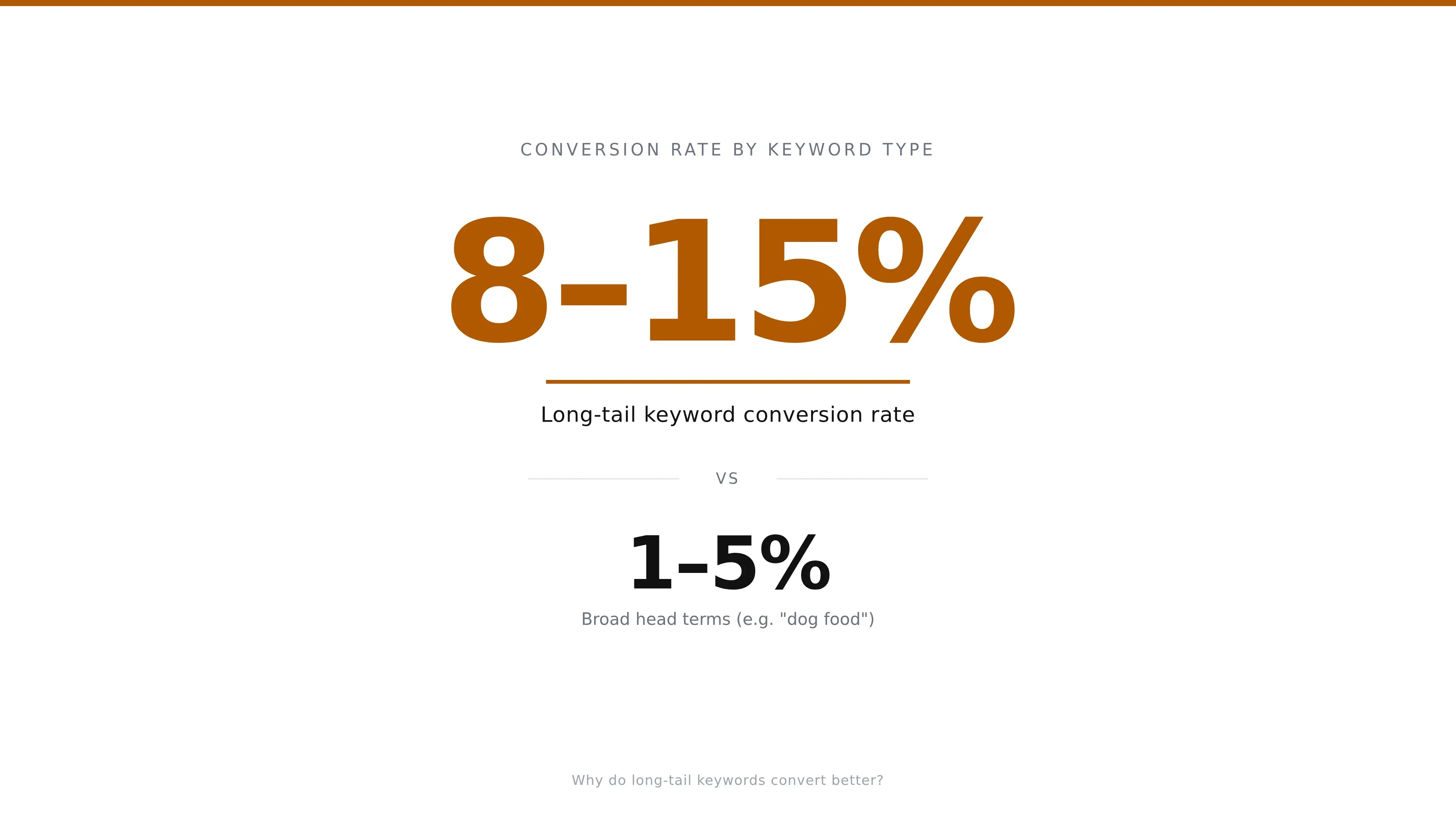
The mechanism is intent. A specific query means the shopper has already narrowed the field - breed, life stage, health need, product type - so your page meets them at the exact point of decision rather than competing for a distracted browser. Less comparison friction, faster purchase.
This is why volume alone is a poor way to judge a keyword. A phrase with 30 monthly searches and explicit buying intent, pointed at a premium product, can out-earn a phrase with 3,000 searches and vague intent. The value of a keyword depends on the intent behind it and the price point of what it sells, not on headline volume.
Building authority through topical clusters
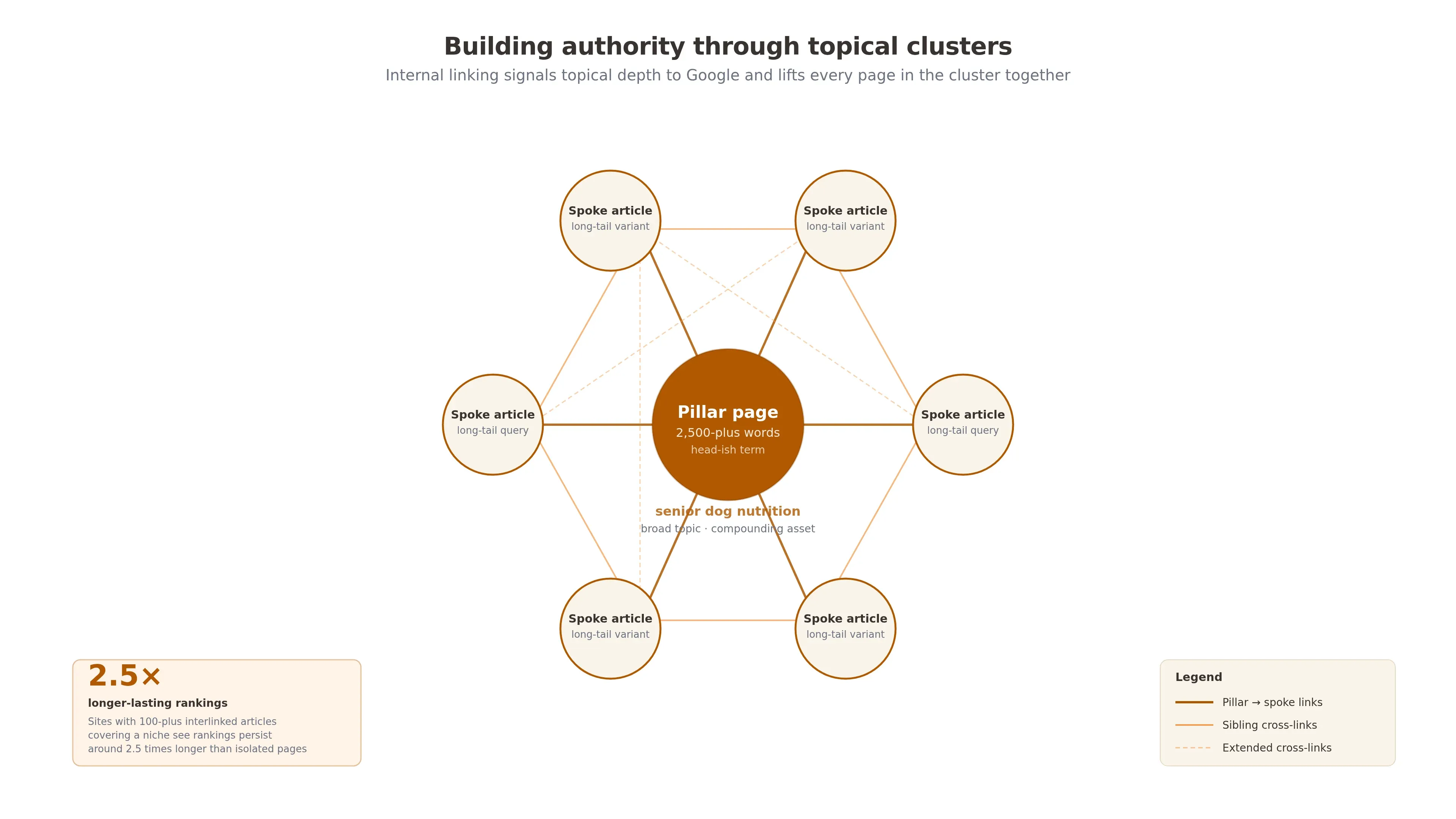
Topical clusters turn individual long-tail pages into a compounding asset. You build one pillar page on a broad topic - say, senior dog nutrition - and link it to six to eight spoke articles targeting long-tail variants. The internal linking signals topical depth to Google and lifts every page in the cluster together.
Pillar and spoke roles
The pillar (typically 2,500-plus words) covers the broad topic and targets the head-ish term; the spokes each own one long-tail query and link back to the pillar and across to two or three siblings, using exact-match or close-variant anchor text. This is "long-tail keywords for ecommerce strategy" in practice - not isolated posts, but a connected map of a single topic.
The payoff is durability. Sites with 100-plus interlinked articles covering a niche see rankings persist around 2.5 times longer than isolated pages, because authority transfers across the cluster instead of resting on one vulnerable page. Our guide to topical authority for independent retailers shows how this lets a small store outmanoeuvre bigger-domain rivals.
The keyword difficulty sweet spot
The keyword difficulty sweet spot for independent pet retailers is roughly 20 to 45 - competitive enough to signal genuine demand, low enough to rank within two to six months with one solid article. Aim below this band while your domain is new, and reach higher only once your clusters have built authority.
Difficulty scores map to site maturity. A new site should start with keywords in the 0 to 30 range, graduating to 20 to 35 by around month six as topical authority accumulates, and reserve difficulty 50-plus for established sites with 18 to 24 months of clustering behind them. Chasing high-difficulty terms too early wastes months on pages that never move.
Clusters change this maths. Because authority transfers between linked pages, a newer site working a tight cluster of lower-difficulty keywords builds rankable authority faster than it would firing off isolated high-difficulty articles. Difficulty thresholds also shift by market and by product price point, so treat the 20 to 45 band as a starting guide rather than a fixed rule.
Long-tail keyword examples across pet categories
Here are concrete long tail keyword examples for pet stores, organised by category. Each maps to one of the four intent buckets and sits in a rankable range for independent retailers. Use them as templates - swap in your own breeds, conditions, and products to build a list that matches your catalogue.
| Query category | Example keyword | Buyer stage | Conversion signal |
|---|---|---|---|
| Breed-specific | best joint supplement for senior German Shepherds | Ready to buy | High |
| Health-condition | grain-free dog food for sensitive stomachs | Problem-aware, comparing | High |
| Product-comparison | fish tank filter vs sump filter | Mid-decision | Medium |
| Local modifier | pet shop near [town] | Ready to buy today | High |
Dog nutrition and health keywords
Dog terms are where breed and health intent overlap most usefully: "best food for French Bulldog puppies", "grain-free dog food for sensitive stomachs", "best joint supplement for senior German Shepherds", "low-fat dog food for pancreatitis". Each pairs a specific dog with a specific need, which is exactly the intent that converts.
Cat care and product keywords
Cat searches lean towards health and product specifics: "sensitive skin cat food", "tick prevention for cats", "low-phosphorus food for cats with kidney disease", "clumping vs non-clumping cat litter". These sit comfortably in the low-difficulty range that a growing store can win.
Small animal, aquatic and reptile niches
The quieter niches are often the easiest to own because the chains barely cover them: "fish tank filter vs sump filter", "best bedding for guinea pigs with allergies", "UVB bulb for bearded dragon", "heat mat vs ceramic heater for reptiles". Low volume, but very little competition and highly committed buyers.
Local and seasonal modifiers
Local terms - "pet shop near [town]", "raw dog food supplier [city]" - convert strongly and face few national rivals; our focused guide to local long-tail keywords for pet shops shows how to rank in your area without paid ads. Seasonal variants ("flea treatment for dogs summer", "winter coat for whippets") reward planning ahead, which is what our walkthrough on building a seasonal long-tail keyword calendar is built for.
How do you turn keywords into a content strategy?
Turn keywords into strategy in four moves: identify eight to twelve rankable long-tail keywords a month, group them into topical clusters of one pillar plus six to eight spokes, publish consistently across three to six months, then track rankings and conversions to sharpen the next round of targeting.
Set realistic timelines
Most retailers see measurable ranking gains within eight to twelve weeks of consistent, interlinked publishing. Market matters, though: in competitive markets such as the UK and Germany, head terms can take six to twelve months, while lower-competition markets like Slovenia, the Czech Republic and Hungary move faster - a five-article Slovenian cluster reached the first page within 20 days and a top-three position within four months. If you're planning across borders, our guide to multi-market long-tail keyword research maps the differences.
Build an editorial rhythm you can sustain
The strategy only compounds if you keep publishing. A new store owner will get more from a simple, repeatable monthly cadence than from a burst of activity that fizzles - our launch checklist for a new pet store turns this into a step-by-step plan. The hard part is doing it every month without a content team.
That's the gap Petbase AI is built to close: it scans your catalogue, identifies your monthly long-tail keywords, and publishes ten strategically linked articles per topic straight to your Shopify, WooCommerce or WordPress store - the same cluster structure described in this guide, produced on a schedule you never have to manage by hand.
The takeaway is simple: stop competing where the chains have already won. Long-tail keywords - specific, high-intent, lower-competition - are the ground where an independent pet store can rank, and topical clusters are what turn a handful of those wins into durable authority. Start with eight to twelve rankable phrases, group them into a pillar and its spokes, and publish consistently. That's the whole game.
Frequently Asked Questions
What are some long-tail keyword examples for a pet shop?
Strong long tail keywords examples for a pet shop include "best joint supplement for senior German Shepherds", "grain-free dog food for sensitive stomachs", "fish tank filter vs sump filter" and "pet shop near [your town]". Each is specific enough to signal clear buying intent and faces far less competition than head terms like "dog food", which is why independent retailers can realistically rank for them.
How do I identify long-tail keywords worth targeting?
Start with the four query categories - breed, health condition, product comparison and local - and generate specific phrases your customers would type for products you actually sell. Then check each phrase's search volume and difficulty, favouring the 20 to 45 difficulty band. Learning how to identify long-tail keywords is mostly about matching genuine buyer intent to terms you can rank for within a few months.
Are low-volume keywords worth targeting?
Yes, when they fit a cluster or point to a higher-priced product. A keyword with 30 monthly searches and explicit intent can generate more revenue than one with 3,000 searches and vague intent, because the specific searcher is ready to buy. Low-volume phrases also gain authority from the pillar and sibling articles around them, so they rarely have to stand alone.
How long until an independent pet store ranks for long-tail keywords?
Most independent pet retailers see measurable ranking gains within eight to twelve weeks of consistent, interlinked publishing. Timelines vary by market: in the UK and Germany, competitive head terms can take six to twelve months, while lower-competition markets like Slovenia, the Czech Republic and Hungary move faster - one Slovenian cluster reached the first page within 20 days. Long-tail terms rank sooner than head terms everywhere.
Sources and Further Reading
Related Reading

Why Breed-Specific Keywords Outperform Generic Pet Searches: A Strategic Guide for Independent Retailers

How to Launch a Long-Tail Keyword Campaign for Your Pet Store: Complete Checklist

Long-Tail Keywords vs Short-Tail Keywords: Why Independent Pet Retailers Can't Compete on Head Terms