International SEO Keyword Research for Pet Retailers: A Multi-Market Strategy


Table of Contents +
- Why Does Market-Specific Keyword Research Matter for Pet Retailers?
- How Does Pet Search Behaviour Differ Across European Markets?
- Which Query Patterns Should You Target in Each Language?
- Competitive Density and Ranking Timelines by Market
- How Do You Research Keywords for Each European Market?
- Which Markets Should You Prioritise First?
- Frequently asked questions
- Sources and further reading
International SEO keyword research for pet retailers: how search terms and competition differ across Germany, the UK and smaller EU markets.
There's a shortcut doing the rounds in pet retail: take the keyword list that ranks your shop at home, run it through a translation tool, and assume you've done your international SEO keyword research for every new market. Translate the pages, publish, and wait for the traffic to arrive.
It rarely does. A translated keyword is not a researched one - it carries your home market's vocabulary, competition and buyer habits into a country that shares none of them. The German phrase real searchers type might look nothing like a literal translation of your best English one, or barely be typed at all. Meanwhile the difficulty you assumed from your home SERP may be nothing like the one you actually face. Get this wrong and you don't lose a week - you spend months publishing pages nobody searches for, in markets where the real opportunity was sitting one untranslated phrase away.
Why Does Market-Specific Keyword Research Matter for Pet Retailers?
Market-specific keyword research matters because demand, competition and vocabulary are all set locally rather than globally. A phrase that converts in the UK may be worded differently - or barely searched - in Germany, and the competition behind it varies just as much. Translating one keyword list carries your home-market assumptions into markets that never shared them.
Independent pet retailers across Germany, the UK, Slovenia, the Czech Republic and Hungary all face one structural reality: head terms like 'dog food' or 'Tierbedarf' are owned by domains rated above 70 - Fressnapf.de sits around 74 and zooplus.de around 75 - and no retailer with limited authority will realistically capture them. Long-tail keywords are the only viable route to a page-one ranking within six months, and long-tail demand is expressed differently in every language.
This is why a genuine long-tail keyword strategy has to be rebuilt per market rather than copied across borders. An international SEO strategy that treats Europe as one audience inherits the wrong terms, the wrong difficulty estimates and the wrong priorities. The markets that look smallest on a spreadsheet are often the ones where you rank fastest - but only if you research them in their own language first.
Petbase builds this SEO foundation automatically for pet businesses - 10 optimized articles published every month - start your free trial.
How Does Pet Search Behaviour Differ Across European Markets?
Pet search behaviour differs by market in phrasing, structure and intent. UK shoppers research heavily, building 'best [product] for [condition]' queries before they buy. German searchers reach for precise product vocabulary. Smaller markets such as Slovenia, the Czech Republic and Hungary search in their own languages, with far less content competing for attention.

UK: research-heavy 'best for' queries
British buyers treat search as a research tool. The dominant template is 'best [product] for [condition]' - 'best food for sensitive digestion', 'best harness for a French Bulldog' - and shoppers work through several of these before a purchase-intent signal appears. Usefully, UK searchers use 'pet shop' and 'pet store' interchangeably, so both belong in your keyword set. Seasonal demand moves the same way, peaking around flea season, winter coats and Christmas, and those peaks don't line up neatly across borders.
Germany: precise product terminology
German search runs on established, specific vocabulary with no direct English equivalent - Tierbedarf (pet supplies), Tierhandlung (pet shop), Hundefutter (dog food), Katzenfutter (cat food), Nassfutter (wet food) and Trockenfutter (dry food). These terms set the competitive benchmarks for German content, and you cannot reach them by translating 'wet food' literally. These market-specific keyword differences are exactly what a translation-first approach misses.
Smaller EU markets: room to breathe
Slovenia, the Czech Republic and Hungary search entirely in their own languages, with lower content saturation. A Hungarian shopper types queries like 'milyen táp jó érzékeny emésztésű kutyának' (what food suits a dog with sensitive digestion) - phrasing you'd never derive from English planning. Less competition here is the whole point, and it sets up the timeline advantage covered further down.
Which Query Patterns Should You Target in Each Language?
Target four query categories in every market: breed-specific, health-condition, product-comparison and local-modifier searches. Each maps to a different stage of the buying journey, and each surfaces in different words in every language. The categories stay constant across borders; the exact phrasing, and which categories dominate, do not.
In pet e-commerce, these long-tail keyword categories typically sit between 50 and 1,000 monthly searches each and move buyers from awareness towards purchase. The four break down like this:
- Breed-specific - 'best food for French Bulldog puppies'. Breed popularity and even breed names vary by market, so this category needs local input more than any other.
- Health-condition - 'grain-free dog food for sensitive stomachs'. The UK's 'best for [condition]' habit lives mostly here.
- Product-comparison - 'fish tank filter versus sump filter'. Comparison intent is strong, but the vocabulary is highly language-specific.
- Local modifiers - 'pet supplies near [location]'. These map directly to physical catchment and local terms.
Because these four query categories each need different framing, a localized SEO strategy means rebuilding all four in the target language rather than translating a finished list. Breed vocabulary is the sharpest example - breed-specific keywords shift with local breed preferences, so a German or Czech breed cluster rarely mirrors your UK one.
Competitive Density and Ranking Timelines by Market
Competitive density decides how fast you rank, and it varies sharply across Europe. In lower-density markets, a five-article Slovenian cluster reached first-page indexing within 20 days and a top-three position within four months, against the 6-12 month timelines typical of Germany and the UK. Less competition means faster returns.
The trade-off is size against speed. Germany and the UK offer the biggest audiences but the toughest SERPs, dominated by high-authority chains and marketplaces. Slovenia, the Czech Republic and Hungary offer smaller audiences but far less competition, so authority builds quickly. Here's how the picture compares:
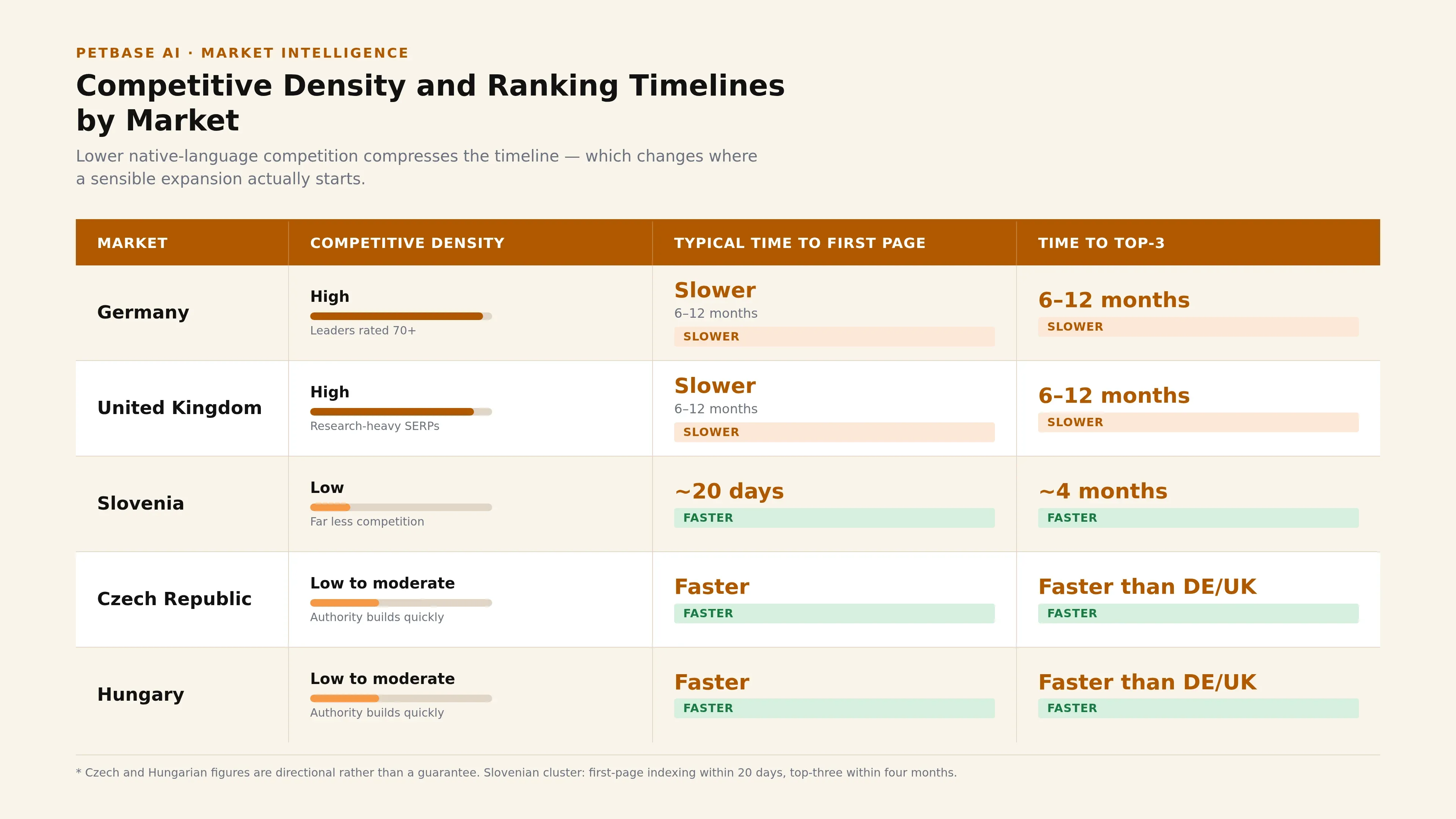
| Market | Competitive density | Typical time to first page | Time to top-3 |
|---|---|---|---|
| Germany | High (leaders rated 70+) | Slower | 6-12 months |
| United Kingdom | High, research-heavy SERPs | Slower | 6-12 months |
| Slovenia | Low | ~20 days | ~4 months |
| Czech Republic | Low to moderate | Faster | Faster than DE/UK |
| Hungary | Low to moderate | Faster | Faster than DE/UK |
The Czech and Hungarian figures aren't as precisely documented as Slovenia's, so treat 'faster' as directional rather than a guarantee. What holds across all three is the pattern: lower native-language competition compresses the timeline, which changes where a sensible expansion actually starts.
How Do You Research Keywords for Each European Market?
Research each market in four moves: build the seed vocabulary in the native language, study who already ranks there, assess difficulty against that market's competition, then shortlist long-tail variants by intent. Run the same steps per country, but never reuse the outputs - the terms, competitors and difficulty scores are local every time.
Think of it as an international SEO checklist you repeat market by market:
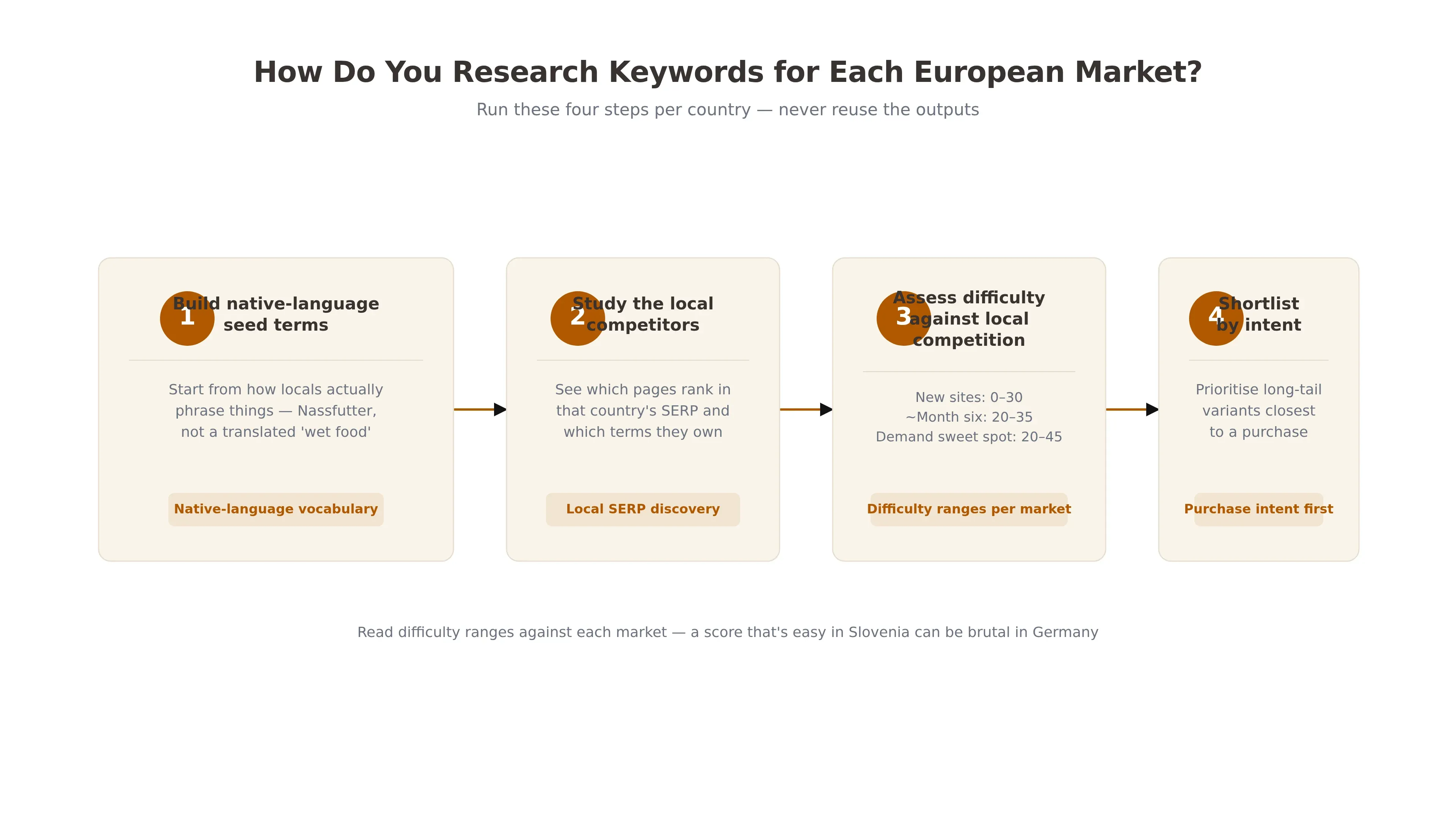
- Build native-language seed terms. Start from how locals actually phrase things - Nassfutter, not a translated 'wet food'. Native speakers or in-market data beat any translation tool here.
- Study the local competitors. See which pages rank in that country's SERP and which terms they own. This is the cross-border extension of finding low-competition keywords: the same discovery workflow, run in a new language.
- Assess difficulty against local competition. New sites should aim for keyword difficulty of roughly 0-30, graduating to 20-35 by around month six as authority grows; a difficulty sweet spot of 20-45 signals real demand while staying winnable. Read those ranges against each market - a score that's easy in Slovenia can be brutal in Germany.
- Shortlist by intent. Prioritise the long-tail variants closest to a purchase, then group them into clusters rather than isolated pages.
This is the workload Petbase AI is built to absorb: it generates content natively in each market's language rather than translating a master version, so the breed, seasonal and terminology differences are researched into the articles from the start rather than patched on afterwards.
Which Markets Should You Prioritise First?
Prioritise the markets where you can rank fastest for the least effort - usually the smaller, lower-competition ones - then reinvest that early traffic into the harder markets. Sequence expansion by competitive density rather than market size alone, and fold each market's keywords into a single connected cluster strategy.
A practical sequence for most independent retailers looks like this: launch first in a lower-density market such as Slovenia, the Czech Republic or Hungary to earn quick wins and prove the cluster model, then move into Germany and the UK, where authority takes 6-12 months to build. Early rankings in the easier markets fund the patience the bigger ones demand.
Whatever the order, integrate every market's keywords into topical authority clusters - a pillar page supported by linked spokes - so authority compounds across related articles instead of scattering across isolated pages. Each market gets its own pillar and its own spokes, in its own language; the structure repeats, the vocabulary doesn't.
This is where doing it once per market becomes the bottleneck. Petbase AI runs market-specific research and native-language cluster construction across Germany, the UK, Slovenia, the Czech Republic and Hungary from one platform, so each market gets its own researched terms and internal linking without a separate editorial pipeline per country.
International SEO keyword research isn't a translation task - it's the same disciplined process repeated market by market, in each market's own language. Get the vocabulary, competition and difficulty right per country, sequence your expansion from the easiest wins to the hardest, and connect everything into topical clusters, and you turn Europe's fragmentation from an obstacle into an advantage.
The catch is volume: doing this properly across five markets is a great deal of research and writing to run by hand. That's the work Petbase AI is designed to automate.
Frequently asked questions
What is international SEO keyword research for pet retailers?
It's the process of researching search keywords separately for each country you sell in, using every market's native language, competition and buyer habits rather than translating a single list. For pet retailers, that means building breed, health, comparison and local queries afresh in German, Hungarian or Slovenian - because the terms real shoppers type rarely match a direct translation of your home-market keywords.
Should I translate my existing keywords or research each market separately?
Research each market separately. Translation carries your home market's vocabulary and competition assumptions into a country that shares neither. German searchers use precise terms like Hundefutter and Nassfutter that no translation tool reliably surfaces, and difficulty scores differ market by market. Build native seed terms, study who ranks locally, then shortlist long-tail variants by intent - every time.
Which European market should a pet retailer target first?
Usually the one where you can rank fastest for the least effort - a lower-competition market such as Slovenia, the Czech Republic or Hungary. A five-article Slovenian cluster reached first-page indexing in about 20 days and a top-three position within four months, against 6-12 months in Germany and the UK. Win there first, then reinvest that traffic into the tougher markets.
How do long-tail keywords differ across pet markets?
The four categories stay the same - breed-specific, health-condition, product-comparison and local-modifier queries - but the phrasing changes in every language, and different categories dominate. UK shoppers lean on 'best [product] for [condition]' research queries, German searchers on precise product nouns, and smaller markets on native phrasing with far less competition. Each category needs rebuilding locally, especially breed vocabulary.