Long-Tail Keywords vs Short-Tail Keywords: Why Independent Pet Retailers Can't Compete on Head Terms


Table of Contents +
- What's the difference between short-tail and long-tail keywords?
- Head-to-head comparison: short-tail vs long-tail keywords
- Why can't independent pet retailers rank on head terms?
- The four query categories where long-tail keywords matter most
- How do you shift your keyword strategy to long-tail keywords?
- Why do topical clusters amplify long-tail keyword performance?
- Common questions
- Sources cited
Long-tail keywords vs short-tail keywords: why independent pet retailers can't win on head terms - and the long-tail strategy that ranks in months.
Every independent pet shop chasing organic traffic eventually reaches the same fork in the road: long-tail keywords vs short-tail keywords. Both are recommended routes to the same destination - a page-one ranking that sends buyers to your own website instead of to Amazon or Fressnapf. Both describe the search phrases you build content around. But they behave in completely different ways, which is exactly why the choice between them decides whether your effort pays off or quietly disappears.
Short-tail terms like "dog food" carry enormous search volume and enormous competition. Long-tail terms like "grain-free dog food for sensitive stomachs" carry less volume but far sharper intent. Pick wrong and the stakes are concrete: you can spend six months publishing content aimed at head terms and never crack the first three pages, because those positions are already held by chains that have spent a decade accumulating domain authority. The traffic you were counting on to fund the next quarter simply never arrives.
This guide sets the two side by side - across volume, difficulty, intent, conversion, and time-to-rank - and shows why the right answer for an independent retailer is rarely the option that looks biggest on paper.
What's the difference between short-tail and long-tail keywords?
Short-tail keywords are broad, one- or two-word queries with high search volume and fierce competition, like "dog food". Long-tail keywords are specific, multi-word phrases with lower volume but clearer intent, like "best food for French Bulldog puppies". The real dividing line is intent specificity and competition, not word count alone.
In pet e-commerce, the standard long-tail keyword definition is a phrase drawing roughly 50 to 1,000 monthly searches, defined by how narrowly it targets a buyer's need rather than by how many words it contains. That is why a single-word query pulling 60 searches a month counts as long-tail, while a five-word phrase pulling 100,000 searches is still a head term.
The practical consequence is that specificity, not length, tells you whether you can win. A shopper typing "grain-free dog food for sensitive stomachs" has already narrowed their choice to a product attribute, a species, and a health need. A shopper typing "dog food" could be after anything - a price comparison, a recipe, or a puppy-feeding guide. The first query signals a buyer; the second signals a browser.
If you want a fuller picture of what these queries look like across a real catalogue, our guide to long tail keyword examples for pet retailers lays out the strategic foundation this comparison builds on.
Petbase automates SEO content for pet stores - publishing 10 optimized articles monthly so you can focus on running your shop - start your free trial.
Head-to-head comparison: short-tail vs long-tail keywords
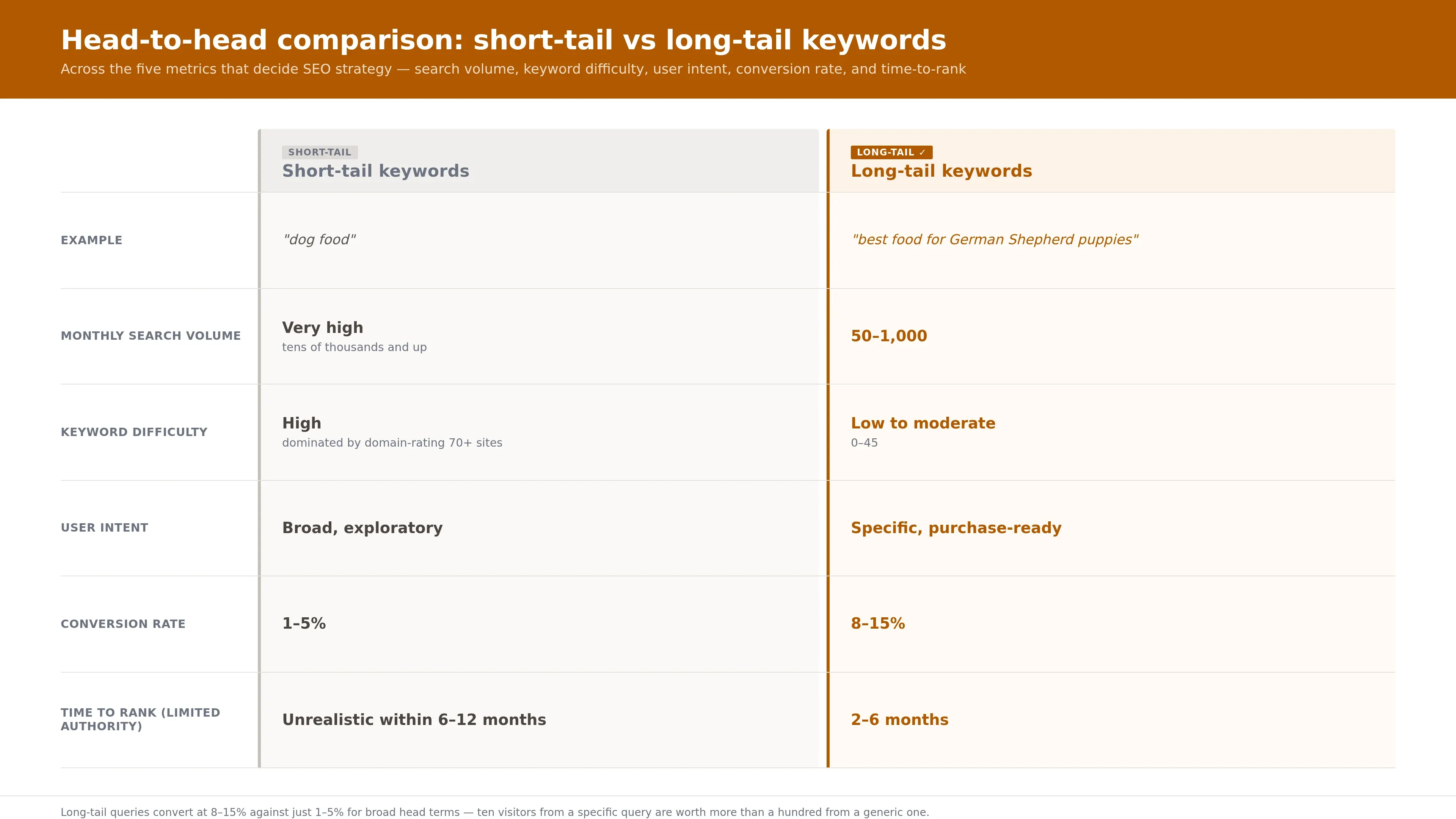
Across the five metrics that matter - search volume, keyword difficulty, user intent, conversion rate, and time-to-rank - short-tail keywords win on raw volume alone. Long-tail keywords win on every dimension that turns a visitor into a paying customer: lower competition, sharper intent, higher conversion, and a realistic path to page one.
| Criterion | Short-tail keywords | Long-tail keywords |
|---|---|---|
| Example | "dog food" | "best food for German Shepherd puppies" |
| Monthly search volume | Very high (tens of thousands and up) | 50-1,000 |
| Keyword difficulty | High, dominated by domain-rating 70+ sites | Low to moderate (0-45) |
| User intent | Broad, exploratory | Specific, purchase-ready |
| Conversion rate | 1-5% | 8-15% |
| Time to rank (limited authority) | Unrealistic within 6-12 months | 2-6 months |
The conversion gap is the figure that should reshape your strategy. Long-tail queries convert at 8-15% against just 1-5% for broad head terms - a conversion rate differential that reflects how much closer a specific searcher already is to buying. Ten visitors from "grain-free dog food for sensitive stomachs" are worth more than a hundred from "dog food", because they arrive knowing what they want.
Read the table as a strategic map rather than a scoreboard. Short-tail terms are not worthless; they are simply out of reach for a store without accumulated authority. Long-tail terms trade volume you cannot capture anyway for conversion and rankability you can.
Why can't independent pet retailers rank on head terms?
Independent pet retailers can't rank on head terms because those positions are already owned by chains with domain ratings above 70 - Fressnapf.de at 74, zooplus.de at 75 - alongside Amazon and Pets at Home. Overtaking a decade of accumulated authority and links is not realistic within six to twelve months of effort.
This is not a reason to abandon organic search; it is a reason to redraw the battlefield. Studies of why small businesses can't compete on head terms reach the same conclusion practitioners see daily: search visibility concentrates on a handful of high-authority domains, and smaller sites gain far more by aligning content with specific user intent than by fighting for saturated head terms.
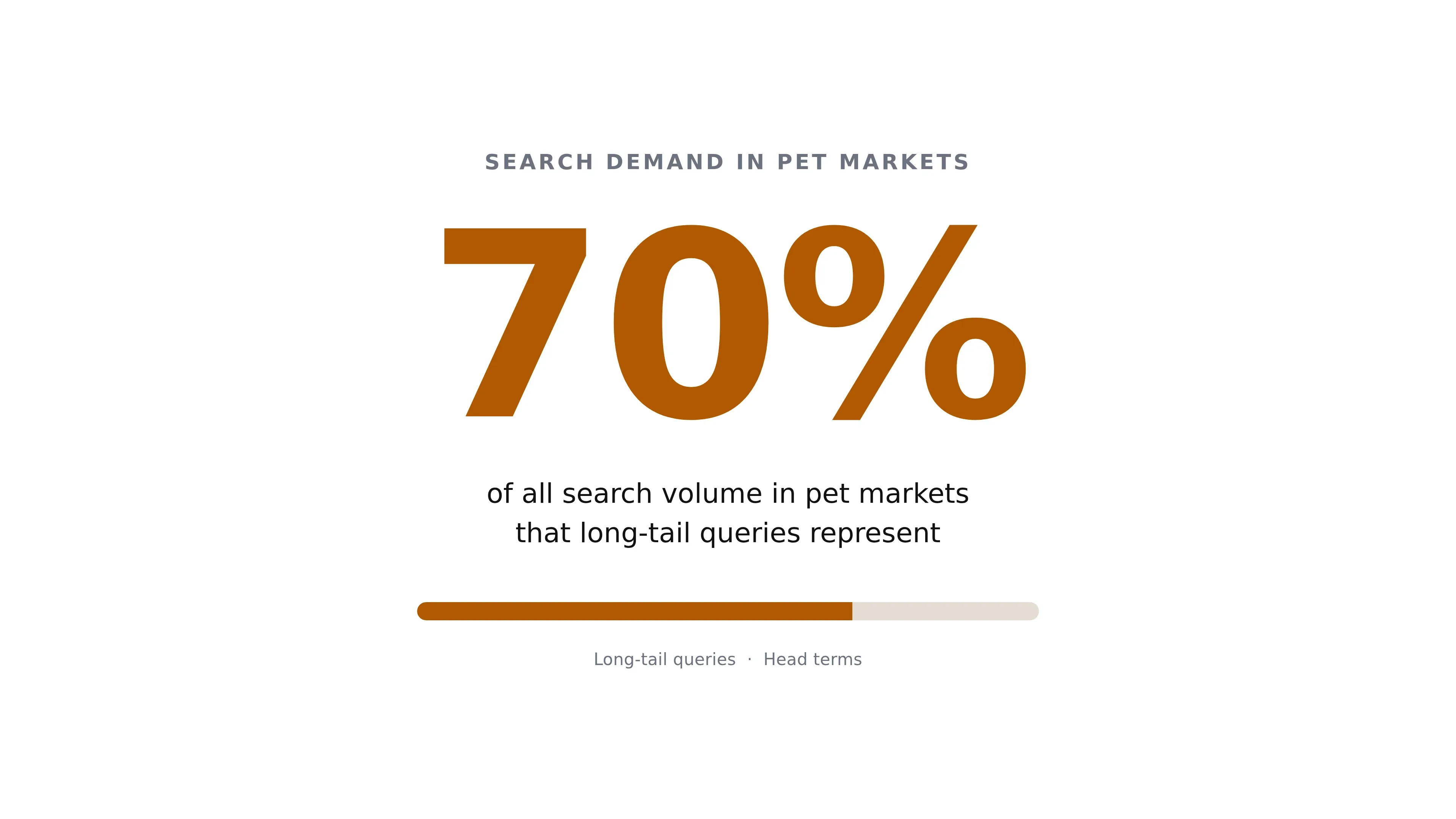
The encouraging part is where the demand actually sits. Long-tail queries make up 70% of all search volume in pet markets. So targeting them is not a consolation prize - it is a claim on the majority of what people are searching for, rather than a scrap over the small, fiercely contested pool of head-term traffic.
Framed that way, the comparison stops being "which type of keyword is better" and becomes "which type is achievable for you". For an independent store, only one answer clears that bar. Long-tail keywords are the structural difference between ranking and being invisible.
The four query categories where long-tail keywords matter most
Four query categories carry the highest intent and lowest competition for pet retailers: breed-specific queries, health-condition queries, product-comparison queries, and local-modifier queries. Each maps to a distinct stage of the buying journey, and each lets an independent store rank where the chains have left specific, high-value gaps wide open.
These query intent categories reward specificity, which is precisely what generic head-term content cannot offer.
Breed-specific queries
Phrases like "best food for French Bulldog puppies" pair a species, a breed, and a life stage. The searcher owns that breed and wants tailored guidance, so competition thins and intent spikes - ideal ground for a store that can write with genuine breed knowledge.
Health-condition queries
Queries such as "grain-free dog food for sensitive stomachs" attach a product attribute to a specific need. These convert strongly because the buyer has already diagnosed the problem and is shopping for the solution, not researching whether one exists.
Product-comparison queries
Comparison phrases like "fish tank filter vs sump filter" catch buyers at the decision point. They are weighing two options and want a clear verdict, which is content large marketplaces rarely produce well for niche categories.
Local-modifier queries
Searches such as "pet shop near me" or "pet store in [town]" carry immediate purchase intent and hand a geographic advantage to independents that national chains struggle to match at street level.
Knowing which category fits your catalogue is only half the job. The other half is finding the low-competition keywords inside each one, so you invest effort where you can genuinely rank.
How do you shift your keyword strategy to long-tail keywords?
Shift to long-tail by starting where you can actually win: target keyword difficulty 0-30 while your site is new, set a floor of roughly 50 monthly searches (lower for high-value products), group related keywords into topical clusters, and publish on a consistent monthly schedule so authority compounds over time.
The mechanics of how to find long tail keywords come down to a repeatable sequence rather than guesswork:
- Match difficulty to your site's age. New sites should begin at difficulty 0-30, where results typically appear in three to six months, then graduate to 20-35 by month six as topical authority grows. The 20-45 band is the long-term sweet spot - low enough to rank, high enough to signal real demand. This mapping of optimal difficulty ranges by site maturity keeps you from chasing terms you cannot yet reach.
- Set a volume floor tied to price point. Around 50 monthly searches makes a standalone page viable, and 100-200 gives steadier traffic. But judge each keyword against what it sells: 20 searches a month can justify a dedicated page for a premium product and not for a low-cost commodity.
- Organise keywords into clusters. Group breed, health-condition, and comparison terms around a shared topic so they reinforce one another rather than competing as isolated pages.
- Publish consistently. Topical authority is cumulative. A steady monthly cadence compounds faster than sporadic bursts of content.
This is where consistency beats heroics - and where most independent retailers stall, because producing a strategically linked cluster every month by hand is genuinely hard. Petbase AI was built to run exactly this play: it generates ten interconnected, long-tail-targeted articles a month, natively in your market's language, and publishes them straight to your CMS so the schedule actually holds.
Why do topical clusters amplify long-tail keyword performance?
Topical clusters amplify long-tail performance because internal linking transfers authority between related pages. One pillar page of 2,500-plus words supports 6-8 spoke articles targeting long-tail variants, cross-linked with exact-match anchor text. This structure signals topical depth to Google and lifts every page in the cluster, not just the strongest one.
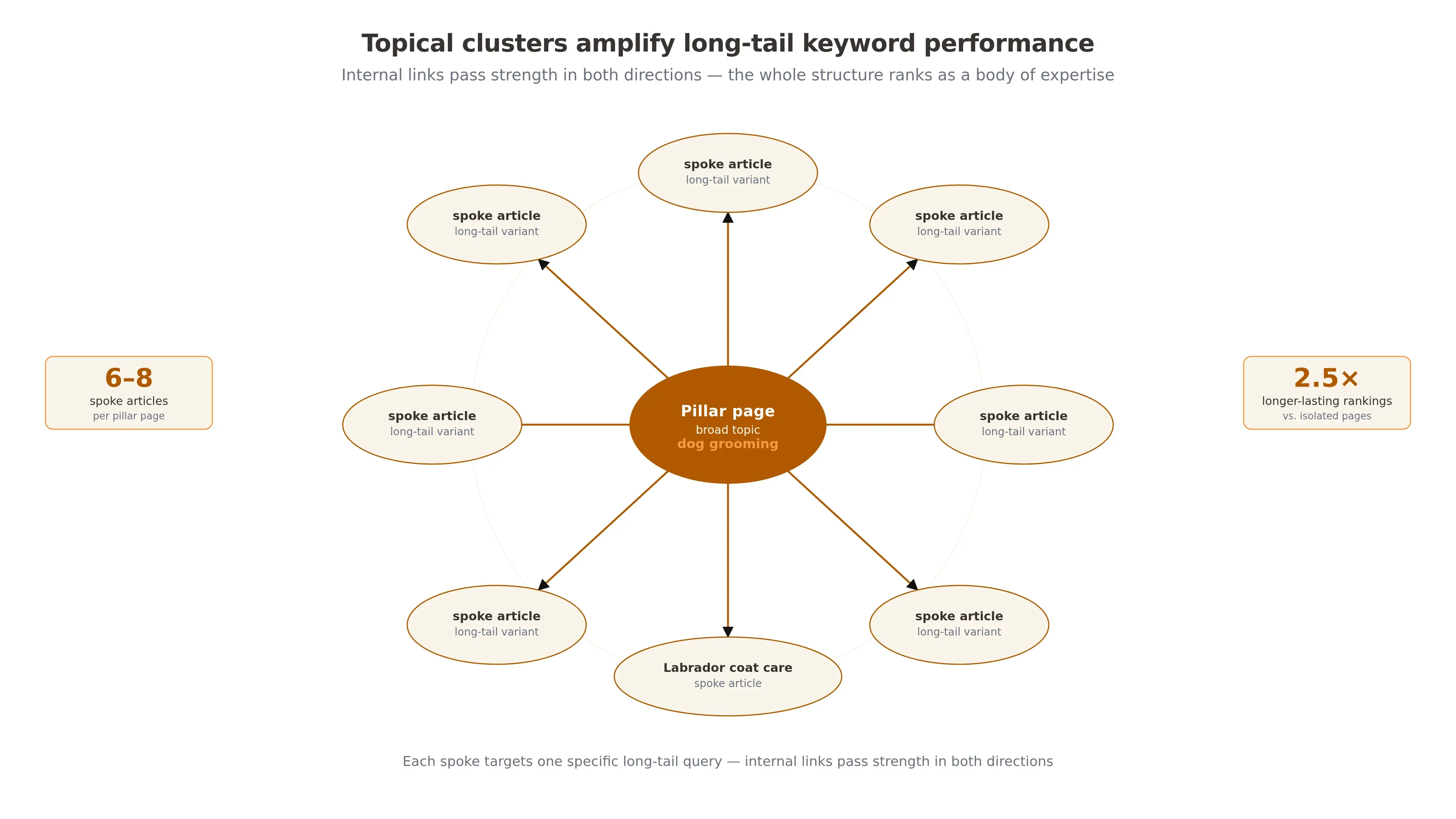
The compounding effect is measurable. Sites with 100+ interlinked articles covering a niche see their rankings persist 2.5 times longer than isolated, unlinked pages. A single article about "Labrador coat care" might draw only a trickle of searches on its own, but as a spoke feeding a "dog grooming" pillar it inherits authority from its siblings and holds position far more reliably.
That is why a cluster beats a scatter of standalone posts. Each spoke targets one specific long-tail query, the pillar covers the broad topic, and the internal links pass strength in both directions - so the whole structure ranks as a body of expertise rather than a set of disconnected pages. Our deeper explanation of topical authority shows exactly how that mechanism lets independent retailers out-manoeuvre bigger rivals.
The broader content plan you build with Petbase AI works on the same principle: monthly clusters that keep extending your topical footprint, so each new article strengthens the ones already published instead of starting from zero.
The comparison resolves cleanly for an independent pet retailer. Short-tail keywords are not better or worse than long-tail keywords in the abstract - they are simply unachievable while your domain authority sits below the chains you compete against. Long-tail keywords give you higher intent, higher conversion, lower difficulty, and a realistic route to page one, all inside the 70% of demand the head-term giants leave on the table.
Your next step is a quick audit. Look hard at your current strategy: are you publishing content aimed at head terms that already rank a hundred competitors deep, or have you mapped the long-tail keywords in your niche where an independent store actually stands a chance? Start with terms in the 50-300 monthly-search range and the 20-35 difficulty band - that is where page-one results show up in three to six months - then organise them into clusters and hold a monthly publishing rhythm.
Common questions
How many monthly searches should a long-tail keyword have before it's worth a dedicated page?
As a general floor, around 50 monthly searches makes a standalone page commercially viable, and 100-200 gives more predictable traffic. But the threshold depends on your product's price point, not volume alone. A phrase with 20 searches a month can justify its own page when it leads to a £150 product, while the same volume rarely pays off for a £5 commodity item.
How long does it take an independent pet store to rank for a long-tail keyword?
For keywords in the 20-45 difficulty band, a single well-optimised article can reach page one within two to six months. New sites should start lower, at difficulty 0-30, where results typically appear in three to six months. Time-to-rank shortens as your topical authority grows, which is why a consistent monthly publishing schedule matters far more than any single article.
What are some long tail keywords examples for a pet shop?
Strong examples fall into four groups: breed-specific phrases like 'best food for French Bulldog puppies', health-condition queries like 'grain-free dog food for sensitive stomachs', product-comparison searches like 'fish tank filter vs sump filter', and local modifiers like 'pet shop near me'. Each is specific enough to signal clear buying intent and low enough in competition for an independent retailer to rank.
Should independent pet retailers ever bother with short-tail keywords?
Short-tail terms are worth understanding, but not worth targeting directly while your domain authority is low, since the head-term positions belong to chains you cannot realistically outrank early on. Treat short-tail phrases as topic labels for your pillar pages rather than ranking goals. As your clusters build authority over 18-24 months, a few moderate head terms gradually come within reach.