Topical Authority in SEO: How Independent Retailers Can Compete Against Bigger Rivals


Table of Contents +
- What Is Topical Authority in SEO?
- Why Does Topical Authority Matter for Independent Retailers?
- How Do Clusters Compound Authority Through Internal Linking?
- Long-Tail Keywords and Topical Authority: Why the Pairing Wins
- How Do You Build a Topical Authority Cluster?
- Topical Authority vs Domain Authority: Which Should Small Retailers Focus On?
- Common Mistakes When Building Topical Authority
- Frequently Asked Questions About Topical Authority
- Sources and References
Learn how topical authority lets independent pet retailers win page-one rankings for niche searches where big chains never built the content depth.
When a pet owner searches for "grain-free food for a sensitive-stomach Cocker Spaniel" and your shop appears above Fressnapf, something happened long before that search ran. Google did not weigh your page in isolation. It read the web of connected articles around it and judged how deeply your site covers that subject - a signal known as topical authority. That hidden judgement, not the size of your brand, decided the ranking.
For most independent retailers the mechanism runs the other way. You publish a genuinely good article, it sinks, and you assume the chains simply won because they are bigger. In reality Google saw one disconnected page with nothing around it to signal expertise, so it defaulted to the domain that had already proven depth. Every isolated post you publish quietly reinforces that verdict - and the traffic keeps flowing to rivals who look, to the algorithm, like the specialists you actually are.
What Is Topical Authority in SEO?
Topical authority is the depth and breadth of expertise a website demonstrates on a specific subject, built through a connected body of content rather than a single page. Unlike domain authority - a whole-site strength score accumulated mainly through backlinks over years - topical authority is earned by covering one topic comprehensively, and it can grow far faster.
The idea traces back to hub-and-spoke information architecture. A central hub page covers a broad subject, and spoke pages branch off to answer each narrower question in detail. When those pages reference one another sensibly, they stop reading as scattered blog posts and start reading as a coherent library - and that coherence is exactly what a search engine interprets as expertise on the subject.
Domain authority and topical authority are often confused, but they measure different things. Domain authority is a whole-site estimate driven mainly by the quantity and quality of backlinks a domain has earned over its lifetime. Topical authority is subject-specific: it asks how completely and credibly your site covers one topic, regardless of how large or old the site is.
For an independent pet retailer, that distinction is liberating. You will not out-backlink a national chain, but you can out-cover them on senior dog nutrition, aquarium filtration or tick prevention. Our guide to long-tail keyword examples maps the groundwork worth laying before you build your first cluster.
Petbase builds this SEO foundation automatically for pet businesses - 10 optimized articles published every month - start your free trial.
Why Does Topical Authority Matter for Independent Retailers?
Topical authority matters because it is the only realistic route to page-one visibility for a retailer that cannot match the domain authority of national chains. Head terms are locked up by sites that spent years accumulating links; niche depth lets you win the specific, high-intent searches those chains never cover properly.
Large chains like Fressnapf (domain rating 74) and zooplus (domain rating 75) dominate generic head terms through accumulated domain authority and link profiles that independent retailers cannot realistically match, a pattern documented in research on SEO as a competitiveness tool for small and medium enterprises. Chasing "dog food" or "pet supplies" is a contest decided before you enter it - the case we set out in full in long-tail versus short-tail keywords.
The demand you can actually reach sits elsewhere. Long-tail queries account for around 70% of all search volume, so the specific, multi-word searches your buyers type are the majority of the market, not a leftover fringe. Topical authority is what lets a smaller site rank for enough of those queries to matter.
There is a second, commercial reason this matters. Retailers that depend entirely on Amazon or zooplus marketplace listings own no indexed, ranking content on their own domain, and hold no control over algorithm shifts, pricing rules or visibility policies. Building topical authority on your own site turns organic search into an asset you control rather than rent.
How Do Clusters Compound Authority Through Internal Linking?
Clusters compound authority through internal linking: a pillar page and its spoke articles pass relevance signals to one another, so every new piece strengthens the whole set rather than standing alone. Sites with 100+ interlinked articles on a niche see rankings persist 2.5 times longer than isolated pages, according to research on helpful content and internal linking.
The structure itself is simple. One pillar page of 2,500 or more words covers a broad subject - "senior dog nutrition", for instance - and 6 to 8 spoke pages each cover a single subtopic in depth. Spokes link up to the pillar and across to two or three siblings, so relevance and ranking signals circulate through the set instead of dead-ending on a lone page. This circulation is why topic clusters for SEO ranking consistently outperform isolated posts.
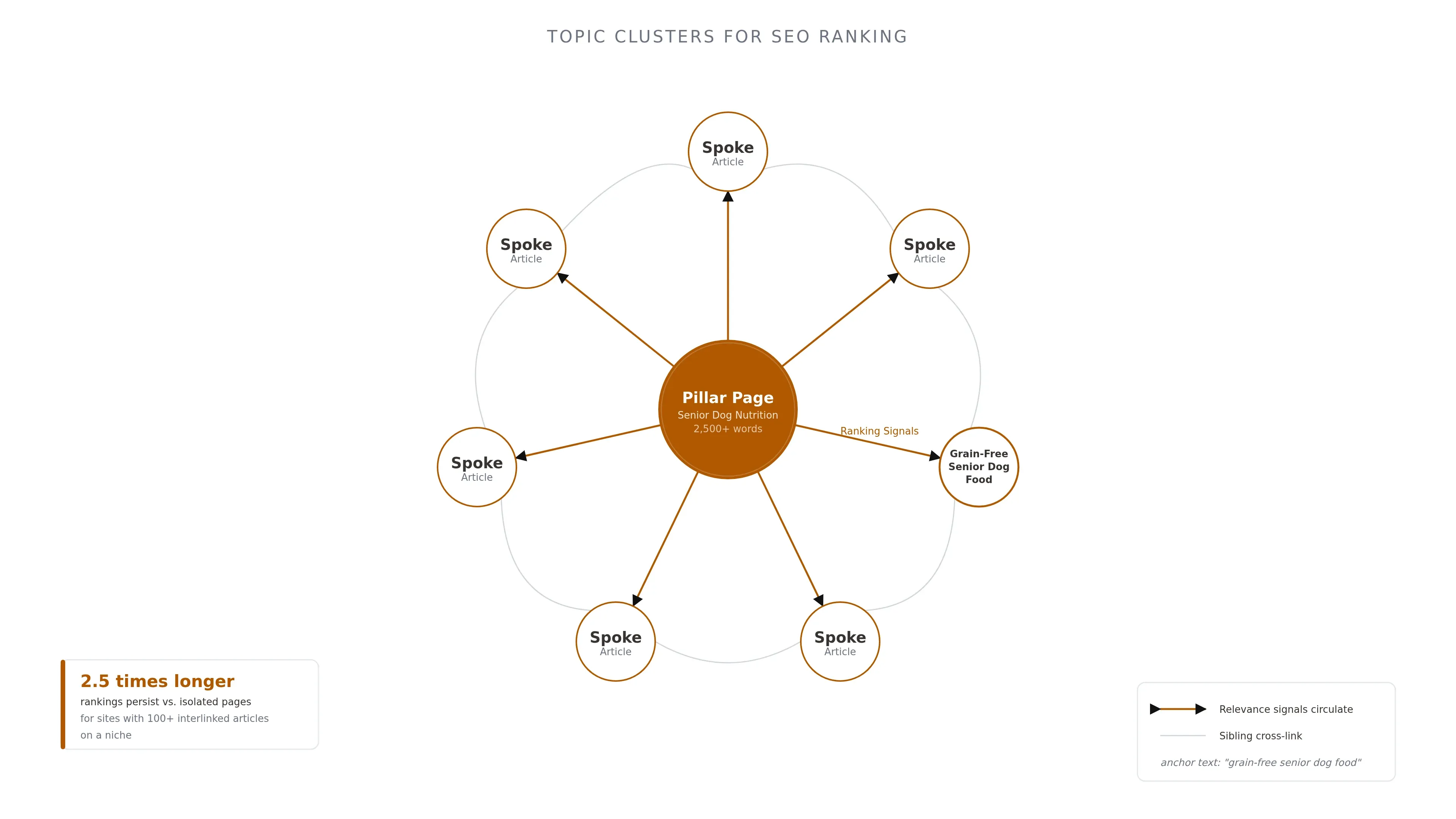
Internal linking is the mechanism doing the work, and anchor text is the lever. Spokes should link with exact-match or close-variant phrases - "grain-free senior dog food", not "click here" - so each link tells the engine precisely what the target page is about. Every new spoke you publish lifts the whole cluster rather than starting from zero, which is exactly what people mean when they say authority compounds.
Long-Tail Keywords and Topical Authority: Why the Pairing Wins
Long-tail keywords and topical authority reinforce each other. Long-tail queries are specific enough that a focused cluster can actually rank for them, and each ranking spoke feeds authority back to the pillar. The pairing turns individually small searches into a compounding system no single head-term page could ever match.
Long-tail queries convert at 8-15%, against 1-5% for broad head terms, because someone searching "grain-free food for a sensitive-stomach French Bulldog" has already narrowed their intent to a precise need - as work on semantic e-commerce search demonstrates. Four query types drive pet retail intent: breed-specific, health-condition, product-comparison and local searches. Turning that intent into rankable pages starts with finding the low-competition long-tail keywords that anchor each cluster.
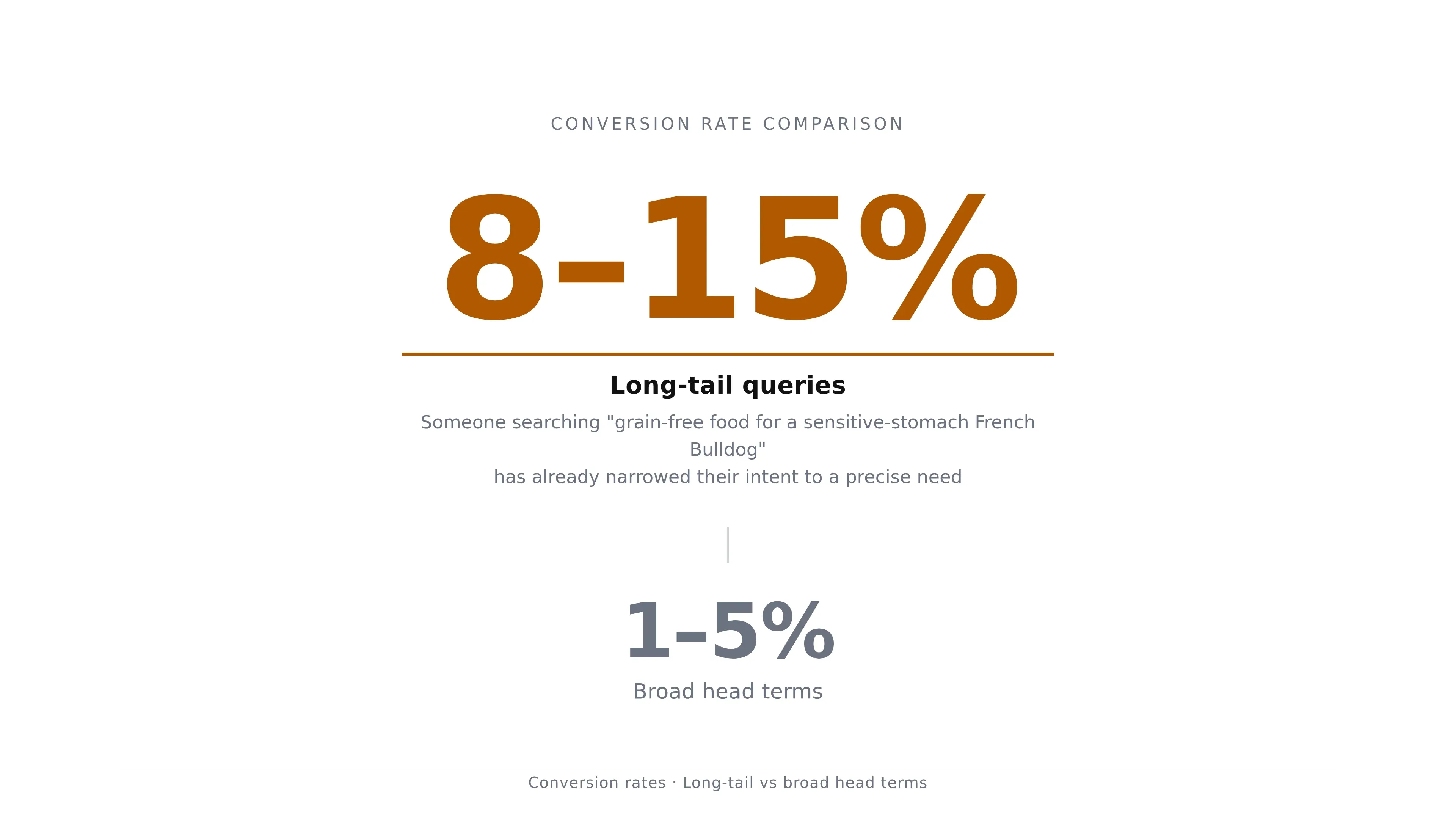
The pairing reinforces itself in both directions. Long-tail specificity makes topical authority achievable, because these are terms a focused site can genuinely rank for. And topical authority makes each long-tail page more powerful, because a ranking spoke transfers relevance back to the pillar and its siblings. Individually modest searches become a compounding system - which no single head-term page could be.
How Do You Build a Topical Authority Cluster?
Building topical authority starts with one pillar article of 2,500 or more words on a broad topic, supported by 6 to 8 spoke articles that each target a specific long-tail variant. Link every spoke back to the pillar, target keywords in a realistic difficulty range, and publish consistently rather than in bursts.
Choose the right keywords first
Start with keyword difficulty in the 20-45 range - competitive enough to signal genuine demand, low enough to rank within two to six months with a single optimised article, according to research on strategic marketing practices for small business competitiveness. Newer sites should begin nearer difficulty 0-30 and graduate upward as authority grows. Apply a rough viability floor of 50 monthly searches for pages meant to stand on their own.
Wire the cluster together
Each spoke links back to the pillar and cross-links to two or three siblings using exact-match or close-variant anchor text. That wiring is what turns separate articles into a cluster the algorithm reads as a single body of expertise. When you are ready to execute, our campaign launch checklist sequences the work from planning to publishing.
Doing all of this by hand - research, link mapping, drafting eight or more articles per topic, then keeping it up month after month - is where most independent retailers stall. Petbase AI runs the whole process: it generates ten strategically linked, EEAT-aligned articles a month, discovers the keywords, cross-links them within semantic topic groups, and publishes straight to your Shopify, WooCommerce or WordPress store. It is the methodology in this guide, executed for you.
Topical Authority vs Domain Authority: Which Should Small Retailers Focus On?
Small retailers should focus on topical authority, not domain authority. Domain authority reflects site-wide backlink strength built over years and cannot be closed quickly against established chains. Topical authority rests on content depth and specificity - factors you control - and can be built in months rather than years.
Domain authority is largely a function of backlinks amassed over years, precisely the asset national chains and marketplaces hold and you do not. Trying to out-link them is a game you cannot win in a realistic timeframe. Topical authority, by contrast, is earned through content depth and specificity, and research comparing authority with topical relevance argues these depth signals matter increasingly in an AI-shaped search landscape. That is what makes a topical authority strategy for small business genuinely winnable.
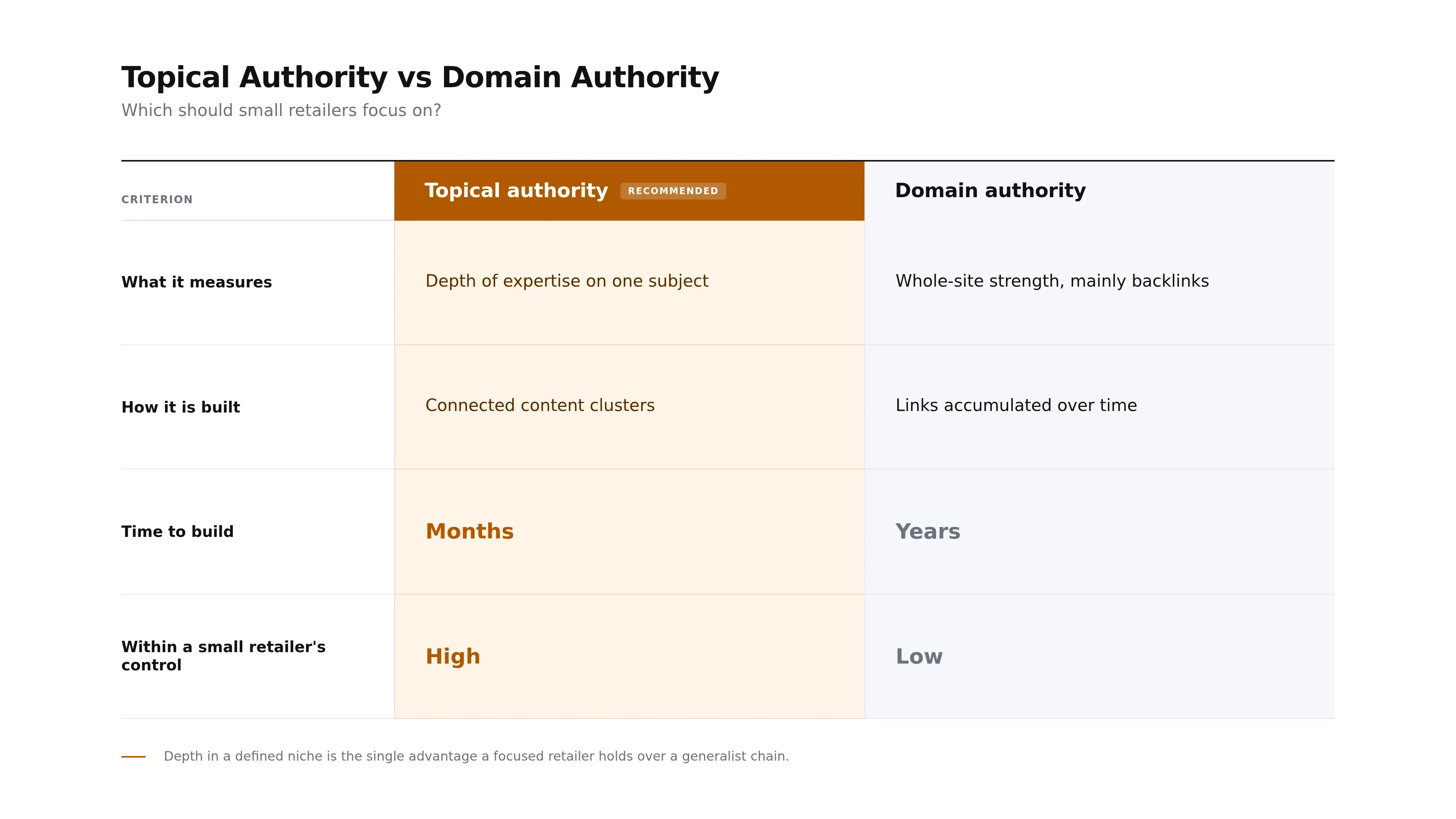
| Criterion | Topical authority | Domain authority |
|---|---|---|
| What it measures | Depth of expertise on one subject | Whole-site strength, mainly backlinks |
| How it is built | Connected content clusters | Links accumulated over time |
| Time to build | Months | Years |
| Within a small retailer's control | High | Low |
The practical implication is a shift in where you spend effort: stop trying to lift a site-wide score you barely influence, and start owning subjects outright. Depth in a defined niche is the single advantage a focused retailer holds over a generalist chain - and it is the one they are least able to copy quickly.
Common Mistakes When Building Topical Authority
The most common mistakes come down to treating content as isolated posts rather than a connected system. Publishing standalone articles, spreading effort across too many topics, neglecting internal links, misjudging keyword difficulty and shipping thin content all stop topical authority from ever compounding - no matter how good any single piece is.
- Treating articles as isolated pages. A post with nothing linking to or from it signals no depth. Google reads it alone and defaults to the domain that has already proven expertise.
- Spreading effort across too many topics. Ten articles on ten unrelated subjects build authority in none. Concentrate on one niche until the cluster is complete before opening the next.
- Ignoring internal linking. Without cross-links, spokes cannot transfer authority and the cluster never compounds into more than the sum of its pages.
- Underestimating keyword difficulty. Chasing difficulty 50+ terms too early wastes months; stay in the 20-45 sweet spot until your authority grows.
- Publishing thin content. Short, shallow pieces do not demonstrate expertise. Each article needs genuine depth to earn its place in the cluster.
The chains win head terms because they spent years earning domain authority. You do not have to fight that battle. By building topical authority - connected clusters of long-tail articles that own a niche completely - you can reach page one in weeks for the specific, high-intent searches those chains never covered properly. Depth and specificity are advantages a focused retailer holds that a generalist cannot easily take back.
The next step is deciding which long-tail keywords anchor your first cluster - the foundation everything else compounds on.
Frequently Asked Questions About Topical Authority
How long does it take to build topical authority?
For independent pet retailers targeting keywords in the difficulty 20-45 range, topical authority can produce page-one rankings within roughly 6 to 12 weeks - far faster than closing a domain authority gap that takes established chains years to build. Timelines vary by market: competition is lighter in smaller EU markets than in Germany or the UK, so rankings can arrive sooner.
How many articles does a topical authority cluster need?
A typical cluster is one pillar article of 2,500 or more words covering a broad topic, supported by 6 to 8 spoke articles that each target a specific long-tail variant. The spokes link back to the pillar and cross-link to two or three siblings, which lets authority flow across the set and demonstrates topical depth to search engines rather than leaving each page to fend for itself.
Should I focus on topical authority or domain authority?
Focus on topical authority. Domain authority reflects site-wide backlink strength accumulated over years, which a small retailer cannot realistically close against national chains. Topical authority rests on content depth and specificity - factors within your control - and can be built in months. It lets you win the high-intent niche searches the chains have never covered comprehensively.
Why can't independent pet stores rank for head-term keywords?
Head terms like "dog food" or "pet supplies" are dominated by chains and marketplaces with domain ratings above 70 - Fressnapf at 74, zooplus at 75 - built on years of accumulated links. Independent retailers cannot match that with realistic effort. Long-tail queries, which make up around 70% of all search volume, are where a smaller site can realistically win.