Local Landing Pages for Groomers: Win ‘Near Me’ and Neighborhood Searches

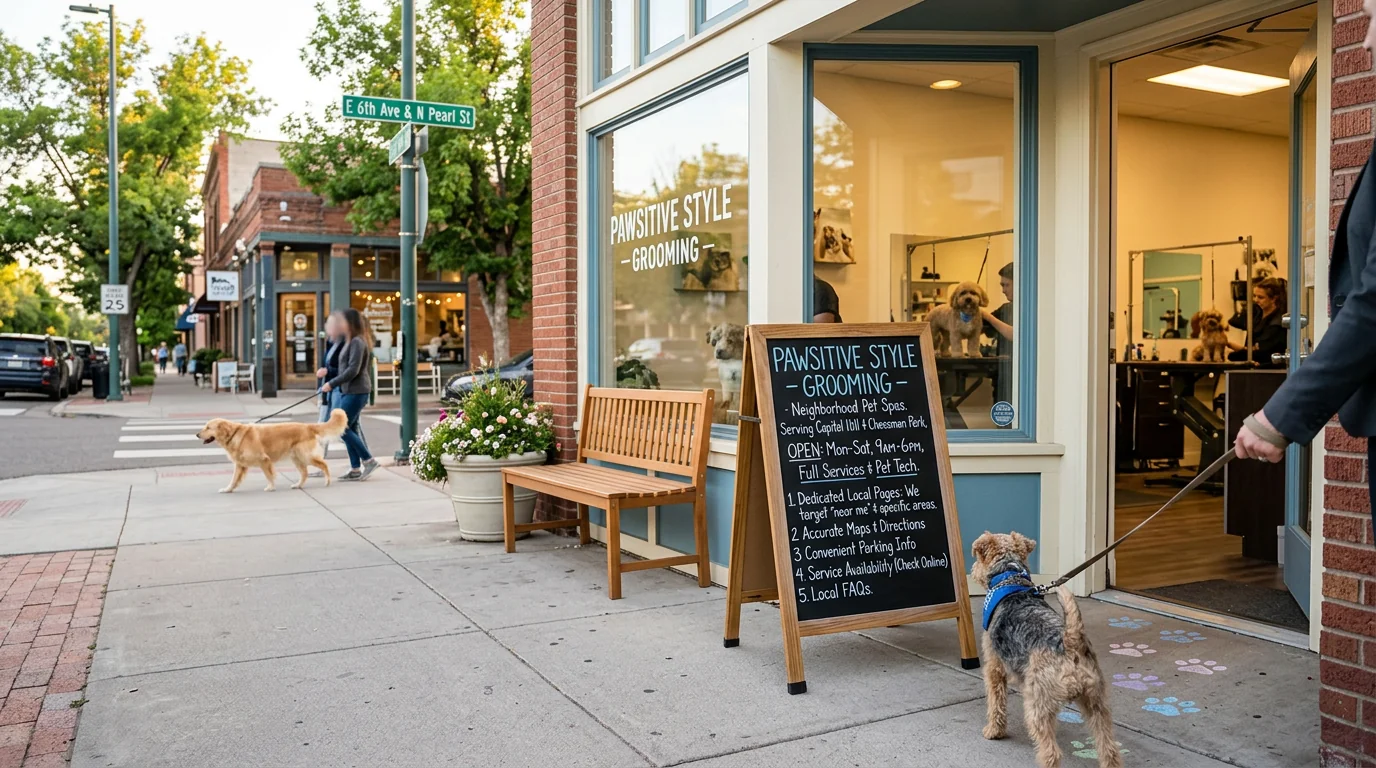
Table of Contents +
- Why local landing pages matter for groomers now
- Quick decision guide: build, merge, or pause pages
- Blueprint: one page per city or neighborhood (with uniqueness safeguards)
- Content components that may move rankings and bookings
- Monitoring: what to check at 7-14 days and 4-8 weeks
- Practical safety boundaries for local pages
- Evidence status: what the data and guidelines suggest
- Implementation checklist (lean vs. enhanced)
- Measurement and iteration loop
- Frequently Asked Questions
- References
Build high-performing local pages for groomers. Cover neighborhoods, directions, parking, and localized FAQs to capture ‘near me’ and city searches.
Your Map Pack visibility looks fine, yet bookings plateau outside your core ZIP codes. The missing link is precise, localized relevance for every neighborhood you serve.
Searchers want nearby options with clear logistics and availability. Neighborhood pages answer that intent and reduce friction to book. This guide shows how to build one page per city or neighborhood with unique content, directions, parking, service availability, and localized FAQs that support bookings.
Why local landing pages matter for groomers now
The core problem: weak geo-coverage beyond your primary city
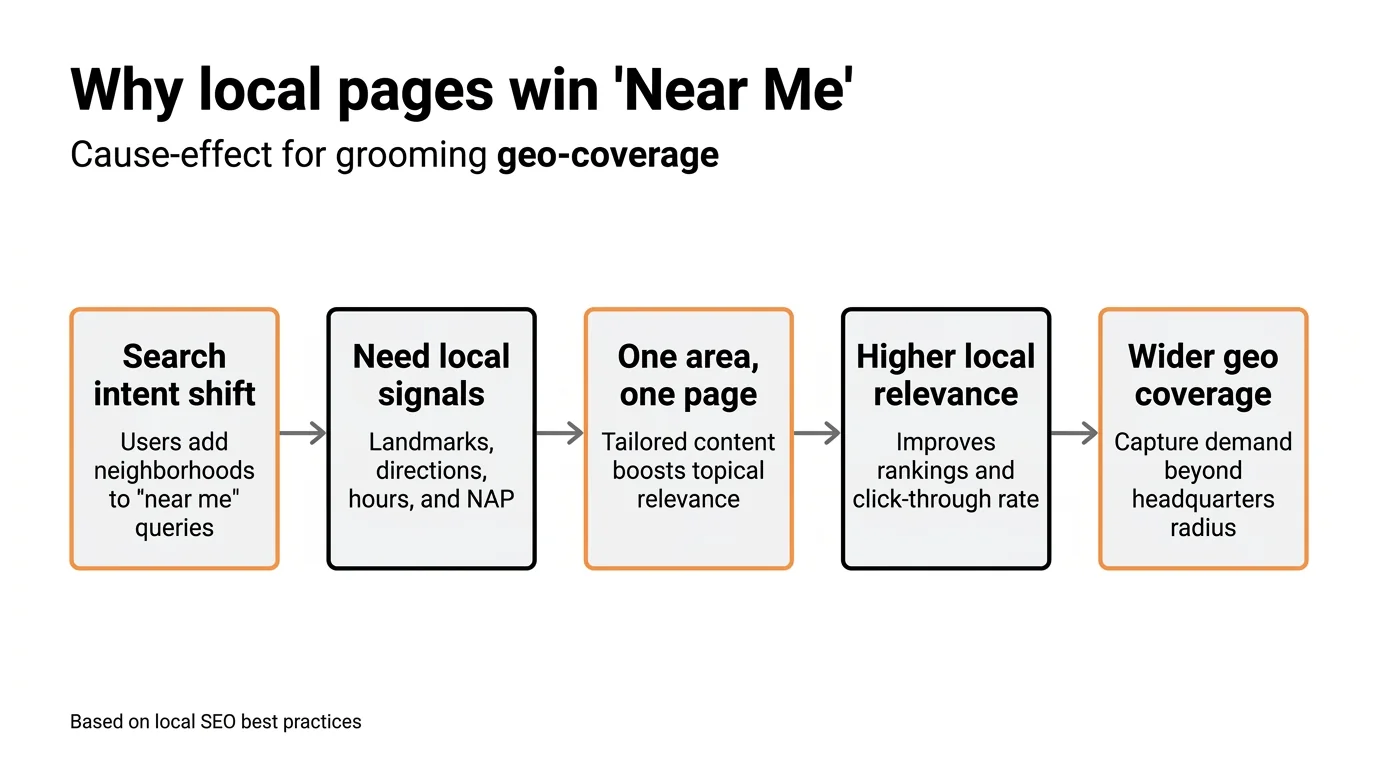
Many grooming sites rank only around their headquarters. That leaves demand untapped in adjacent neighborhoods. Weak geo-coverage often stems from generic sitewide content, no local proof, and missing access details like parking or transit. “Groomer near me SEO” is competitive. Precision around local cues may create entry points into long-tail queries.
How ‘near me’ intent maps to dedicated neighborhood pages
Users searching “best groomer in [Neighborhood]” expect hyper-local signals. One page per area lets you tailor relevance: landmarks, drive-times, and service notes. Optimization research indicates that focusing efforts within smaller, well-scoped regions can improve outcomes compared to broad, undifferentiated approaches[4].
Where this fits in your SEO orientation hub
Local pages complement your Map Pack and core service pages. Place them within a structured site section and connect them to your SEO orientation hub. This reinforces topical depth while keeping navigation clear.
Petbase writes and publishes this kind of content automatically - 10 SEO articles per month for pet businesses - start your free trial.
Quick decision guide: build, merge, or pause pages
If X, then Y: 6 common grooming scenarios
- If inquiries cluster in three adjacent neighborhoods, build three distinct pages with unique logistics and visuals.
- If two areas share identical details and low demand, merge into one robust city hub.
- If you have zero localized photos or directions, pause and collect assets before publishing.
- If mobile grooming hours and fees differ by zone, publish separate service-area pages with explicit availability notes.
- If one area drives calls but poor conversions, rebuild with transit, parking, and price anchors.
- If impressions rise but rankings stall, strengthen internal links and add local proof before adding new pages.
Blueprint: one page per city or neighborhood (with uniqueness safeguards)
URL structure and page taxonomy
Use a clean hierarchy: /grooming/locations/city/ or /grooming/locations/city/neighborhood/. Keep it consistent across the site. Add breadcrumb navigation: Home > Grooming > Locations > City/Neighborhood. Ensure each level is crawlable and linked in your main grooming category. This taxonomy prevents “service-area sprawl” while enabling scalable “grooming location pages.”
On-page must-haves: NAP, directions, parking, availability
Each page must show exact NAP, clickable phone, booking button, and open hours. Add driving directions from common landmarks, public transit notes, and parking guidance with fees or time limits. Include a small “today’s availability” note and upcoming slot windows. Link back to your core offerings with a clear route to high-intent grooming service pages to pass relevance and support conversions.
Content differentiation: photos, cues, and localized FAQs
Use unique exterior and interior photos, nearby landmarks, and staff quotes tied to that area. Add a localized FAQ covering travel times, seasonal parking changes, and noise or pet restrictions in buildings. Optimization techniques suggest using penalties or diversification tactics to avoid repetitive solutions, which aligns with de-duplicating patterns across pages[1].
Schema and technical elements
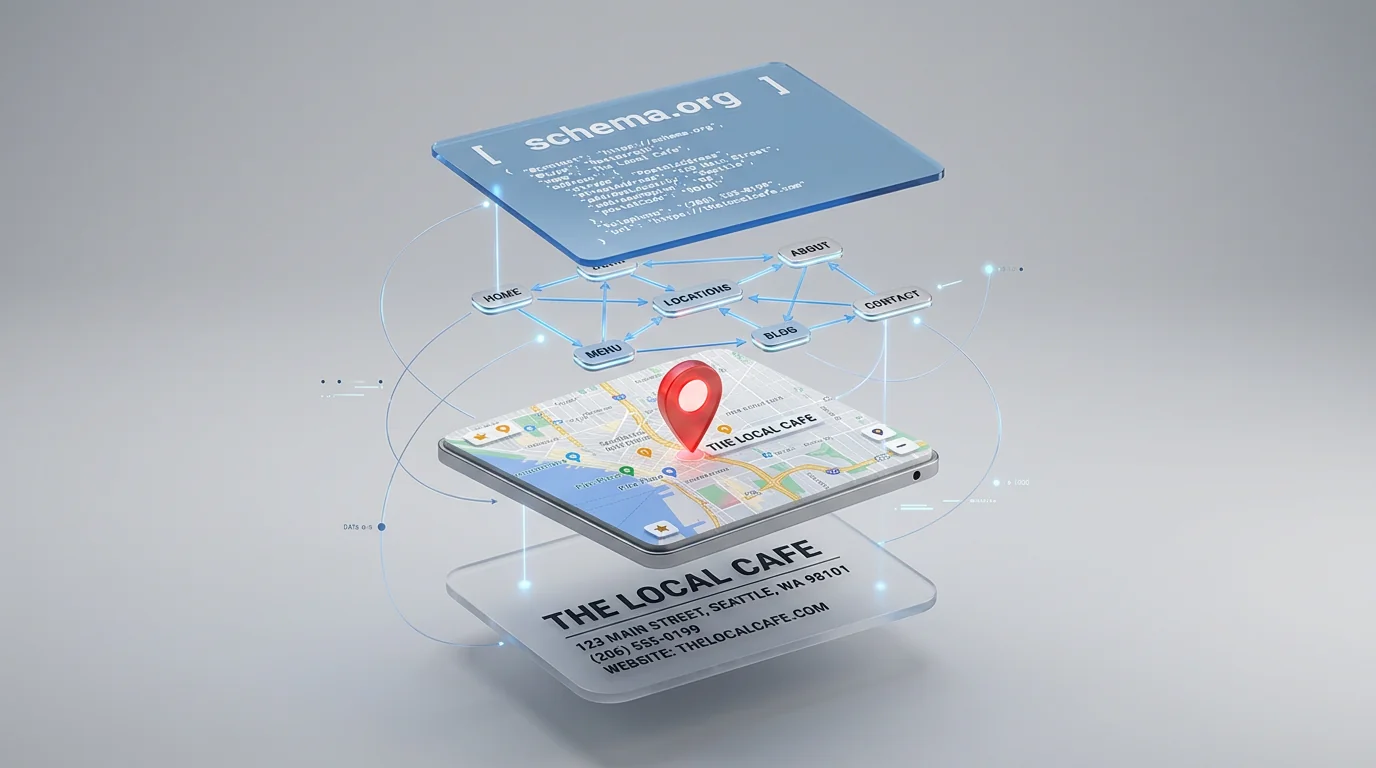
Implement LocalBusiness schema with location-level attributes. Add sameAs for profiles, geo coordinates, serviceArea, and openingHours. Use unique images with descriptive alt text. Build internal links between nearby neighborhoods to guide discovery. Sync content with your Map Pack presence; see the Google Business Profile for Groomers guide for listing best practices.
Content components that may move rankings and bookings
Service availability by neighborhood and breed constraints
State what is available in that area: full groom, express bath, dematting limits, or coat-type constraints. If breed size affects scheduling, disclose it. City service pages for grooming must clarify what can be done on-site versus mobile to match intent and minimize drop-offs.
Transit, parking, and access notes
Transit details cut friction. Add steps from the nearest station, elevator access, curbside drop-off, and ADA notes. Include peak traffic windows and preferred turns. “Neighborhood SEO for groomers” benefits when real-world logistics are addressed, because proximity is more than distance; it is convenience and certainty.
Price anchors and slot capacity indicators
Use price ranges or “from” pricing to set expectations. Show indicators like “Same-day trims available” or “Weekend baths filling fast.” Link to your detailed pricing framework if available, and keep numbers consistent across the site to build trust.
Local proof: reviews, before/after, staff badges
Feature neighborhood-specific testimonials, staff certifications, and before/after galleries. Mark review snippets with appropriate structured data. An iterative approach to content refinement-similar to adaptive local search methods-may improve outcomes as signals accumulate[3]. Encourage reviews tied to that location to support authority.
Monitoring: what to check at 7-14 days and 4-8 weeks
Early signals and indexing
After 7-14 days, confirm indexing in Search Console and check coverage status. Track impressions for “groomer near me,” “[Neighborhood] groomer,” and brand + neighborhood queries. Validate that your Google Business Profile groomer attributes and hours align with the page. Early testing may guide targeted adjustments before full rollout.
Mid-term performance and refinement
At 4-8 weeks, evaluate clicks, calls, direction requests, and booked slots tied to each page. Iterative optimization disciplines show that local, feedback-driven refinement can outperform broad, static strategies in complex environments[4]. For robust attribution and event tracking, use the KPI framework in SEO KPIs for Grooming Shops.
Practical safety boundaries for local pages
Duplicate content, thin pages, and service-area sprawl
Avoid publishing dozens of near-identical pages. Each must include unique visuals, directions, availability, and local proof. If you cannot differentiate two areas, consolidate. Keep crawlable pagination and avoid orphaned pages. Focus on neighborhoods with measurable demand.
Accuracy, claims, and user safety on grooming services
Use cautious language around results and time estimates. Keep pricing, hours, and restrictions accurate. Avoid promises that create risk during grooming services. Update pages quickly when policies or service availability change to protect users and maintain trust.
Evidence status: what the data and guidelines suggest
What is well-supported vs. still emerging
Strong signals include precise NAP, localized content, internal linking, and consistent schemas. Iterative, locality-focused strategies echo findings in local optimization research where constrained, adaptive searches improve efficiency[1][2]. The exact weighting of elements like photos versus reviews remains context-dependent and may vary by market.
Implementation checklist (lean vs. enhanced)
Minimum viable page
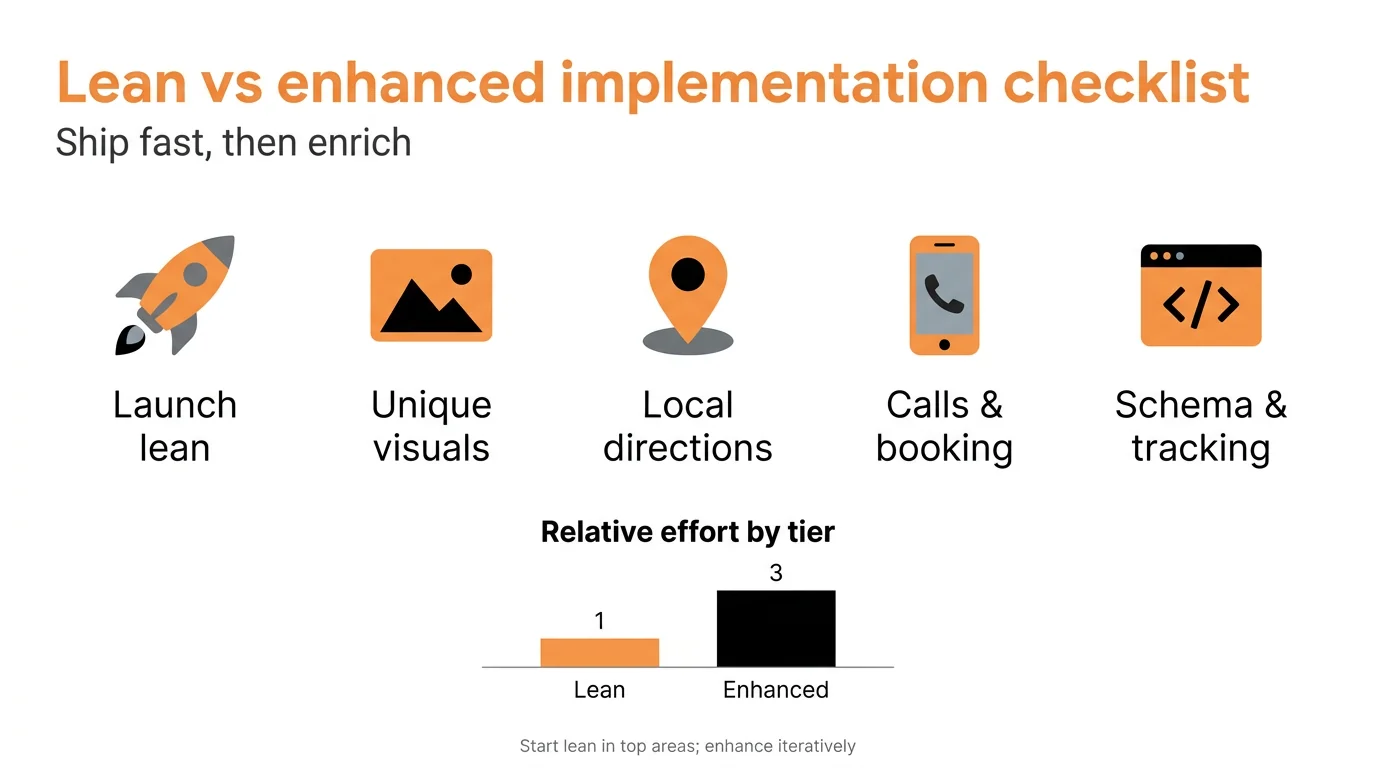
- One city or neighborhood per URL in a consistent /grooming/locations/ structure.
- Unique NAP, hours, driving directions, transit notes, and parking specifics.
- Two location-specific photos and at least one localized testimonial.
- Clear links to core services via high-intent grooming service pages.
- LocalBusiness schema with geo and openingHours, plus internal breadcrumbs.
Enhanced page with automation and localization
- Dynamic “next available” slot indicator and staffed hours by day.
- Localized FAQs, seasonal parking advisories, and real neighborhood landmarks.
- Review carousels filtered for the area, plus staff bios with certifications.
- Programmatic image alt text and FAQ Schema at scale. For best results, consider using Petbase AI which is designed for this purpose.
Measurement and iteration loop
Query mapping and internal linking adjustments
Map queries to each page: “city service pages grooming,” “neighborhood SEO for groomers,” and “groomer near me SEO” variants. If cannibalization occurs, strengthen the most relevant page with internal links and refine titles and H1s. Align GBP landing URLs with the most conversion-capable page.
When to merge, split, or expand pages
Merge two areas if one consistently underperforms and duplicates user intent. Split a city into sub-neighborhoods if impressions surge but conversions differ by sub-area. Evidence from multi-strategy optimization suggests adjusting the search neighborhood can improve convergence on better solutions over time[2].
Frequently Asked Questions
How many local landing pages should a grooming business create?
Start with top 3-5 cities or neighborhoods where you already get inquiries or have proximity. Expand as unique content and demand justify. Avoid publishing dozens of thin pages at once.
What makes each grooming location page unique enough?
Use location-specific photos, staff highlights, precise directions and parking info, service availability nuances, localized FAQs, and neighborhood testimonials. This may help differentiate and avoid near-duplicate risk.
Should I create separate pages for mobile grooming service areas?
Yes, when service availability, travel fees, or time windows differ by neighborhood or city. If details are identical across areas, consider a consolidated service-area hub to reduce duplication.
Do I need a Google Business Profile for each page?
A single physical location typically maps to one GBP. For service-area coverage, GBP guidelines suggest setting service areas rather than creating extra listings. Pages can still target specific areas without separate GBPs.
How long until local landing pages impact rankings?
Indexing may occur within days, while meaningful ranking shifts often take 4-8 weeks. Competitive areas or brand-new sites may require longer and additional links, reviews, and content improvements.
Local landing pages give groomers structured, location-level relevance that may convert “near me” intent into booked appointments. Focus on one page per neighborhood, with unique logistics, local proof, and clear availability. Monitor early signals, refine with evidence, and iterate thoughtfully as demand patterns emerge. Tie these pages to your navigation and core services for authority flow, and maintain accuracy to protect users. Done well, this becomes a sustainable engine for neighborhood discovery and reliable bookings.
References
- C Voudouris et al. (2025). Guided local search. Handbook of Heuristics. View article
- I Ahmadianfar et al. (2022). INFO: An efficient optimization algorithm based on weighted mean of vectors. Expert Systems with …. View article
- D Santos-Martins et al. (2021). Accelerating AutoDock4 with GPUs and Gradient-Based Local Search. Journal of chemical …. View article
- D Eriksson et al. (2019). Scalable global optimization via local Bayesian optimization. Advances in neural …. View article