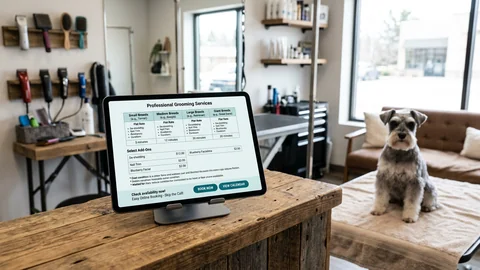
High-Intent Grooming Service Pages: From Dog Bath to Full Groom

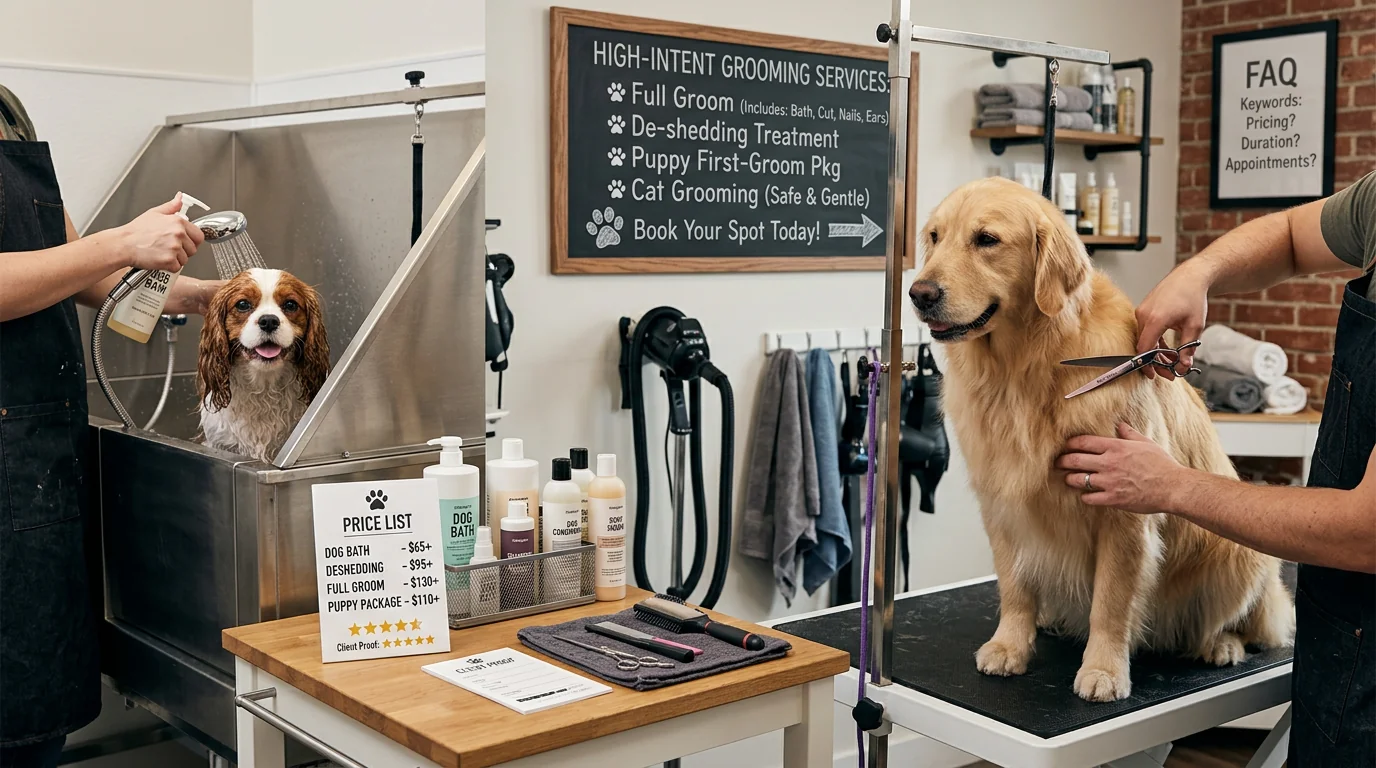
Table of Contents +
- The decision: one service per page to capture high-intent searches
- Page blueprint: content blocks that searchers expect
- Quick decision guide: if X, then Y
- On-page SEO details that move the needle
- Monitoring: what to watch at 7-14 days and 4-8 weeks
- Safety boundaries: accurate claims and pet welfare standards
- Evidence status: what we know and what’s emerging
- Templates: example wireframes for four core services
- Position within your cluster: connect to the complete grooming SEO guide
- Frequently Asked Questions
- References
Design grooming service pages for dog bath to full groom that rank on high-intent keywords and convert with pricing cues, proof, and FAQs.
Generic grooming pages leak bookings. Searchers want a specific service, in a specific place, with clear pricing and proof. Meet that intent, and conversions often follow.
This matters because transactional searches drive revenue. Aligning pages to a single service may reduce friction and improve clarity. You will learn how to structure grooming service pages, map keywords, implement schema, and monitor early signals.
The decision: one service per page to capture high-intent searches
Why splitting “Dog Bath”, “Deshedding”, “Full Groom”, and “Cat Grooming” may increase intent match
Service specificity clarifies value, reduces confusion, and matches transactional searches. A dedicated dog bath service page addresses quick-clean intent. Likewise, a cat grooming landing page sets safety expectations. Evidence suggests that improving clarity and access improves uptake of grooming services[2].
Mapping keywords to page types without cannibalization
Assign one primary intent per page. Use “dog bath service page,” “deshedding service keywords,” “full groom SEO,” and “cat grooming landing page” as distinct targets. Add city or neighborhood modifiers to H1s and URLs to prevent overlap.
Petbase writes and publishes this kind of content automatically - 10 SEO articles per month for pet businesses - start your free trial.
Page blueprint: content blocks that searchers expect
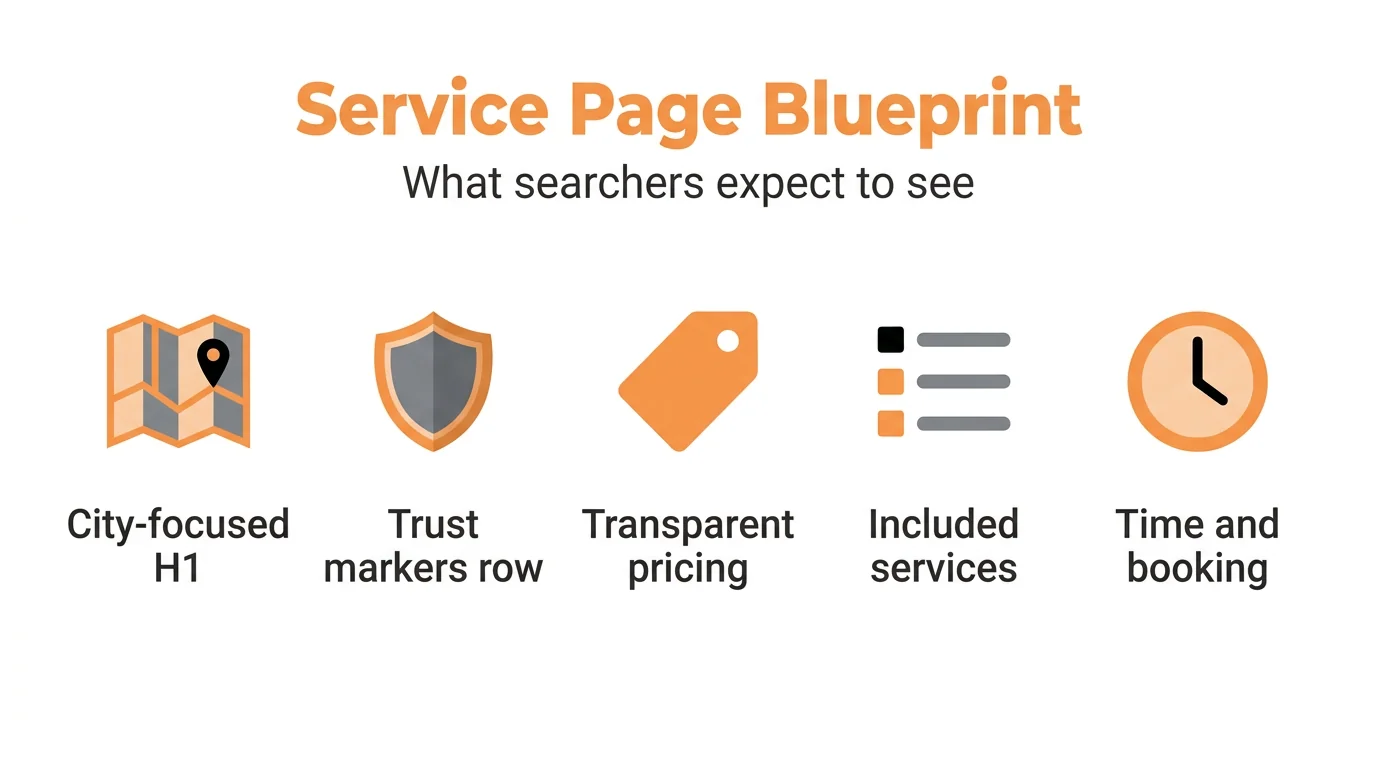
Above-the-fold: service name, location modifier, trust marker trio
Lead with “Dog Bath in [City]” or “Cat Grooming in [Neighborhood].” Add three trust markers: average rating, years in business, and fear-free or safety training badges. Keep the opener scannable and unmistakable.
Pricing cues: ranges, what’s included, time windows
Use honest ranges by size or coat: e.g., small bath $30-$45, full groom $70-$120. Include what’s covered, likely add-ons, and time windows. Time estimates benefit from data-driven planning methods[4].
Proof stack: before/after, breed examples, sanitation standards
Show before/after sets labeled by breed and coat condition. Add short captions explaining tasks and timing. Include sanitation protocols and tool disinfection notes. This practical proof may build trust faster than generic galleries.
Policy clarity: coat condition, matting fees, medical limits
State evaluation steps, humane de-matting limits, and referral criteria. Note that extreme matting may require shave-downs or vet involvement. Clear medical limits protect pets and reduce disputes at the counter.
Conversion helpers: availability widget, neighborhood badges, parking notes
Add live availability, nearby neighborhood badges, and parking or drop-off notes. Include ADA access details if applicable. For puppy grooming package SEO, call out age minimums and vaccination requirements to set expectations.
Structured data: LocalBusiness + Service + FAQ integration
Implement LocalBusiness with exact NAP, plus Service markup per offering, and FAQPage for common questions. Align services and serviceArea fields for clarity. This may reduce ambiguity for search engines.
Quick decision guide: if X, then Y
If competing with aggregator directories, then add neighborhood and landmark modifiers in H1/H2
Use “[Service] in [Neighborhood] near [Landmark]” to distinguish intent. Add map snippets and walking-time notes for hyperlocal relevance.
If multi-species, then separate dog vs. cat services and cross-link with breed/coat examples
Keep species-specific pages. Cross-link sections highlighting coat types, temperament notes, and handling differences to guide readers confidently.
If most calls ask about price, then show price ranges with inclusions and exclusions
Present size or coat-based ranges, list what’s included, and outline add-on fees. Note evaluation steps for matting and special handling.
If cancellations are high, then surface policies and deposit terms above FAQs
Place cancellation windows, rebooking rules, and deposits near CTAs. Confirm policy acceptance during booking to reduce no-shows.
If image proof is thin, then prioritize before/after by coat type over generic gallery
Replace mixed galleries with paired transformations per coat type. Tag images with breed and condition to answer trust gaps.
If you serve mobile grooming, then add service radius, travel fees, and driveway requirements
Publish a precise radius, travel surcharges, and parking or power needs. Offer a map and simple address checker.
If you upsell add-ons, then create modular add-on cards with transparent time and price
Show nail grinding, teeth brushing, and de-skunking as modular blocks. Include added minutes and price per add-on to set expectations.
On-page SEO details that move the needle
Primary keyword placement and local modifiers
Put the core keyword in H1 and title tag with the main city. Use secondary neighborhoods in H2s. Keep meta descriptions action-oriented with proof cues and time windows to encourage clicks.
Internal linking anchors and hub spoke alignment
Link each service page to your hub and sibling services with exact anchors. Maintain short breadcrumb paths. This keeps intent signals clear and reduces mixed queries reaching the wrong page.
Media optimization: alt text by breed/coat/job
Write alt text like “Before after deshedding for Husky, heavy undercoat.” Compress images, use WebP, and lazy-load below-the-fold content. Add filenames with breed and service names for relevance.
FAQ selection to mirror People Also Ask
Mine People Also Ask and call logs. Select four to six concise answers using the language clients use. Structure FAQs to preempt price, safety, timing, and policies.
Schema nuances to reduce ambiguity
Use @id for business identity across pages, define Service for each offering, and map serviceArea. Add hasOfferCatalog for add-ons. For broader local strategy, see local landing pages for groomers and a weekly content plan that builds topical authority. For faster execution, many teams use Petbase AI to generate consistent markup and content blocks.
Monitoring: what to watch at 7-14 days and 4-8 weeks
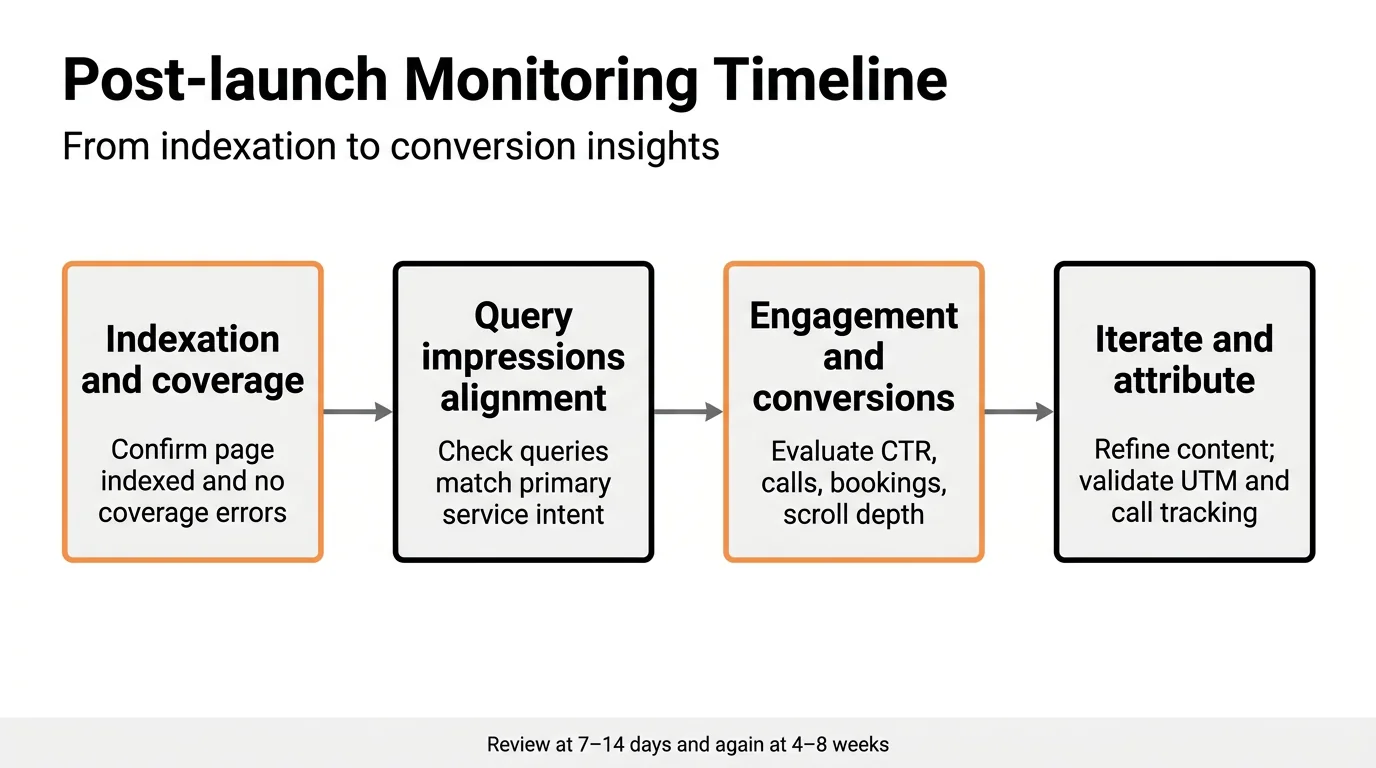
7-14 days: indexation, query mix, impression lift
Check indexation status, impressions by query, and brand vs. non-brand ratios. Confirm queries align with the page’s primary intent. Watch coverage for service, city, and neighborhood modifiers.
4-8 weeks: click-through, calls/messages, booking starts, scroll depth
Evaluate CTR, calls or messages from the page, booking funnel starts, and scroll depth to FAQs and pricing. Attribute outcomes using UTM tags and call tracking where permitted.
Diagnostic cues: cannibalization, thin intent, SERP feature gaps
If pages swap positions on similar queries, tighten on-page intent and internal anchors. Add richer FAQs, schema, or proof assets to win sitelinks or image packs. Track with SEO KPIs for grooming shops.
Safety boundaries: accurate claims and pet welfare standards
Avoid overpromising on coat recovery and timing
Set realistic expectations for matting recovery and appointment duration. Dogs unfamiliar with grooming may show stress cues, affecting timing and approach. Acknowledge this variability in your estimates[3].
State handling limits, matting policies, and vet-referral criteria
Publish humane handling limits, de-matting caps, and when shave-downs or vet referrals are required. Clear thresholds protect staff and animals and reduce disputes at checkout.
Accessibility, allergen, and sanitation disclosures
Describe fragrance-free options, disinfectant protocols, and ventilation. Include ADA access, parking, and elevator notes. Practical disclosures help clients plan and may reduce anxiety for sensitive animals and owners[2].
Evidence status: what we know and what’s emerging
Evidence suggests service-specific pages improve intent alignment
Local grooming demand varies by access, knowledge, and service clarity. Content that clarifies service availability and steps may improve engagement and bookings in underserved segments[2].
Pricing visibility may support conversion and reduce bounce
Transparent ranges and what’s included address common barriers like uncertainty and affordability perceptions. Clear, upfront information helps clients decide where to book or seek assistance programs when needed[1].
FAQ and schema usage may correlate with richer SERP coverage
Using structured FAQs and clear service markup may help search engines interpret offerings. Richer SERPs can increase earned visibility for transactional terms without extra ad spend.
Breed/coat imagery may increase engagement in local niches
Before/after sets by coat type set expectations and reduce surprises at drop-off. Visual clarity may also reduce stress by informing owners about handling and time variability[3].
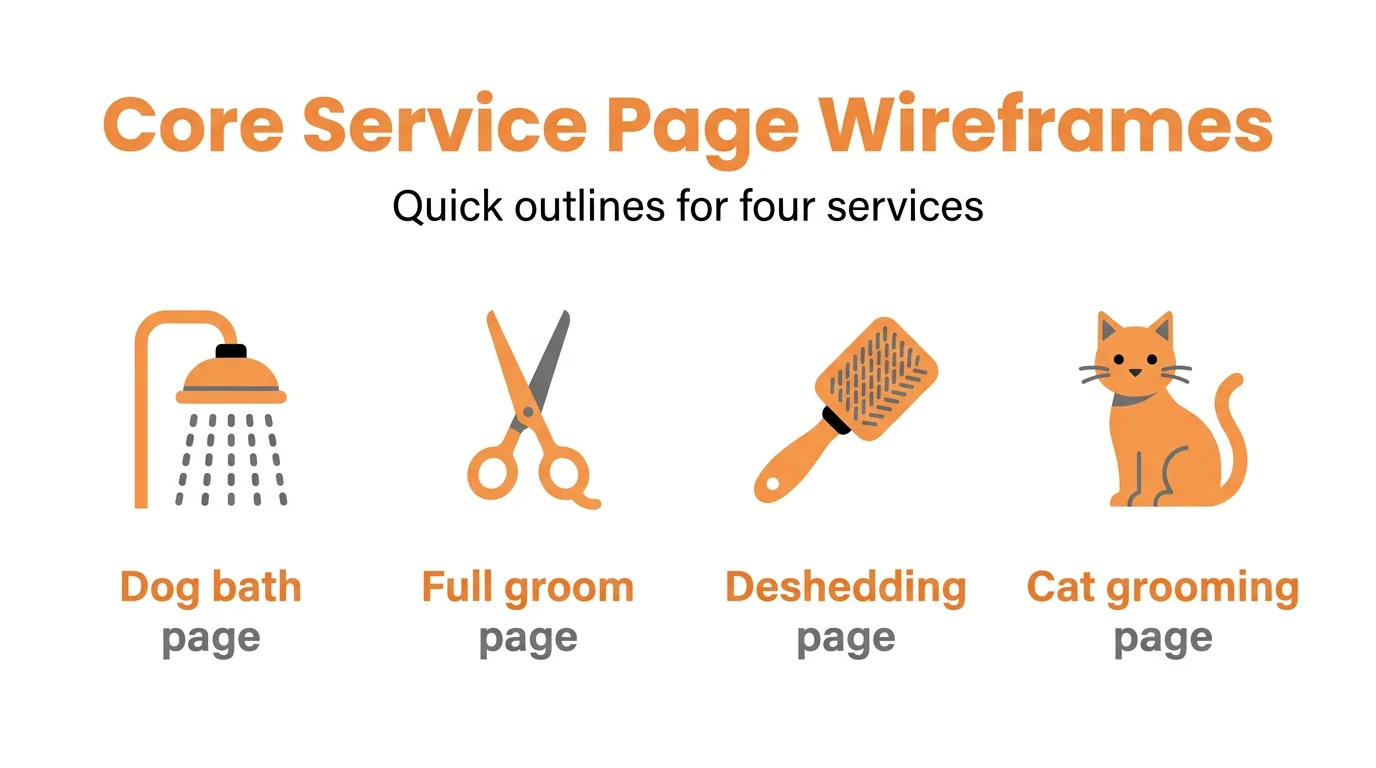
Templates: example wireframes for four core services
Dog Bath page layout (query variants and content order)
Target variants: “dog bath near me,” “express dog wash [city].” Order: H1 with city, short benefit row, price range by size, what’s included, time window, proof by breed, policies, FAQs, booking CTA. See also Full Groom, Deshedding, and Cat Grooming.
Full Groom page layout (policies and proof emphasis)
Target variants: “full groom SEO,” “full service grooming [city].” Order: H1, transformation proof, tiered pricing, inclusions/exclusions, matting and style policies, time windows, sanitation notes, FAQs, booking CTA. Cross-link to Dog Bath, Deshedding, and Cat Grooming.
Deshedding page layout (coat types and time blocks)
Target variants: “deshedding service keywords,” “[breed] undercoat removal [city].” Order: H1, coat-type education, time blocks, add-on cards, before/after on double coats, policies, FAQs, booking CTA. Cross-link to Dog Bath, Full Groom, and Cat Grooming.
Cat Grooming page layout (safety boundaries and handling)
Target variants: “cat grooming landing page,” “lion cut [city].” Order: H1, handling credentials, quiet-room protocol, pricing ranges, sedation policy note, vet-referral criteria, FAQs, booking CTA. Cross-link to Dog Bath, Full Groom, and Deshedding.
Position within your cluster: connect to the complete grooming SEO guide
Where to place hub links and sibling service links
Link each service page back to your grooming SEO hub from the footer or sidebar. Interlink sibling services with exact anchors. Keep irrelevant cross-links off the page to avoid diluting intent.
Anchor text guidance and sequence of internal links
Use exact-match anchors for primary services and descriptive anchors for proof or policies. Sequence links near pricing and FAQs to guide action, not distract from booking.
Frequently Asked Questions
Should each grooming service have its own page or be combined?
Evidence suggests separate pages for dog bath, deshedding, full groom, and cat grooming may better match transactional intent and reduce keyword cannibalization. Keep a hub page to connect them.
How much pricing detail should a grooming service page include?
Listing price ranges with what’s included, add-on fees, and time windows may support conversion and reduce calls. Avoid fixed quotes if coat condition varies; note evaluation steps.
What schema should a grooming service page use?
LocalBusiness plus Service and FAQPage markup may help search engines interpret offerings. Ensure NAP consistency, service area, and review snippets where permitted.
Do before/after photos impact bookings?
Before/after sets tagged by breed and coat condition may increase engagement and trust. Include alt text and brief process notes to clarify context.
How do I avoid keyword cannibalization across services?
Use one primary intent per page, differentiate H1/H2s with the specific service and location, and interlink sibling pages using exact-match anchors for clarity.
Conclusion
High-intent grooming service pages win by aligning one intent, clear pricing, visible proof, and reliable schema. Start with dog bath, deshedding, full groom, and cat grooming. Then measure and refine. For broader strategy, connect each page to your complete grooming SEO guide to strengthen authority and internal clarity.
References
- SE McDonald et al. (2022). Barriers to and facilitators of pet grooming among clients served by a subsidized grooming service program. Frontiers in veterinary …. View article
- SE McDonald et al. (2022). Grooming-related concerns among companion animals: preliminary data on an overlooked topic and considerations for animals' access to health-related services. Frontiers in Veterinary …. View article
- M Ferreira et al. (2022). Stress in dogs during grooming in a pet shop. Revista Brasileira de …. View article
- N Pannurat et al. (2023). Machine learning techniques for supporting dog grooming services. Results in Control and …. View article