SEO KPIs for Grooming Shops: What to Track and How to Attribute Bookings

Table of Contents +
- Why KPIs matter for grooming bookings (and what this guide solves)
- Define your KPI stack for a grooming shop
- Set up accurate attribution without guesswork
- Implement goals and events step-by-step
- Quick decisions: if X happens, do Y
- Monitoring: what to watch at 7-14 days and 4-8 weeks
- Practical limits and safety margins
- State of the evidence and cautions
- Templates and KPI examples for grooming
- Frequently Asked Questions
- Next step: align KPIs with your complete strategy
- References
Understand key SEO KPIs for grooming shops, set goals, and attribute bookings with UTM, call tracking, and GMB data. Clear steps and safe benchmarks.
Organic search may drive calls and website visits, yet bookings remain unclear. That gap makes marketing decisions risky. You need a reliable way to connect visibility and clicks to confirmed appointments.
This guide defines the essential grooming shop SEO metrics that signal revenue. You will learn how to configure GA4 events, UTM naming, call tracking, and booking attribution. You will leave with a practical, defensible KPI framework.
Why KPIs matter for grooming bookings (and what this guide solves)
The single scenario: unclear ROI from local search
Most grooming shops see traffic from search, but cannot prove which visits create bookings. The fix is aligning analytics metrics with decision-grade KPIs that map to the sales funnel stages.[1]
How this framework ties metrics to actual appointments
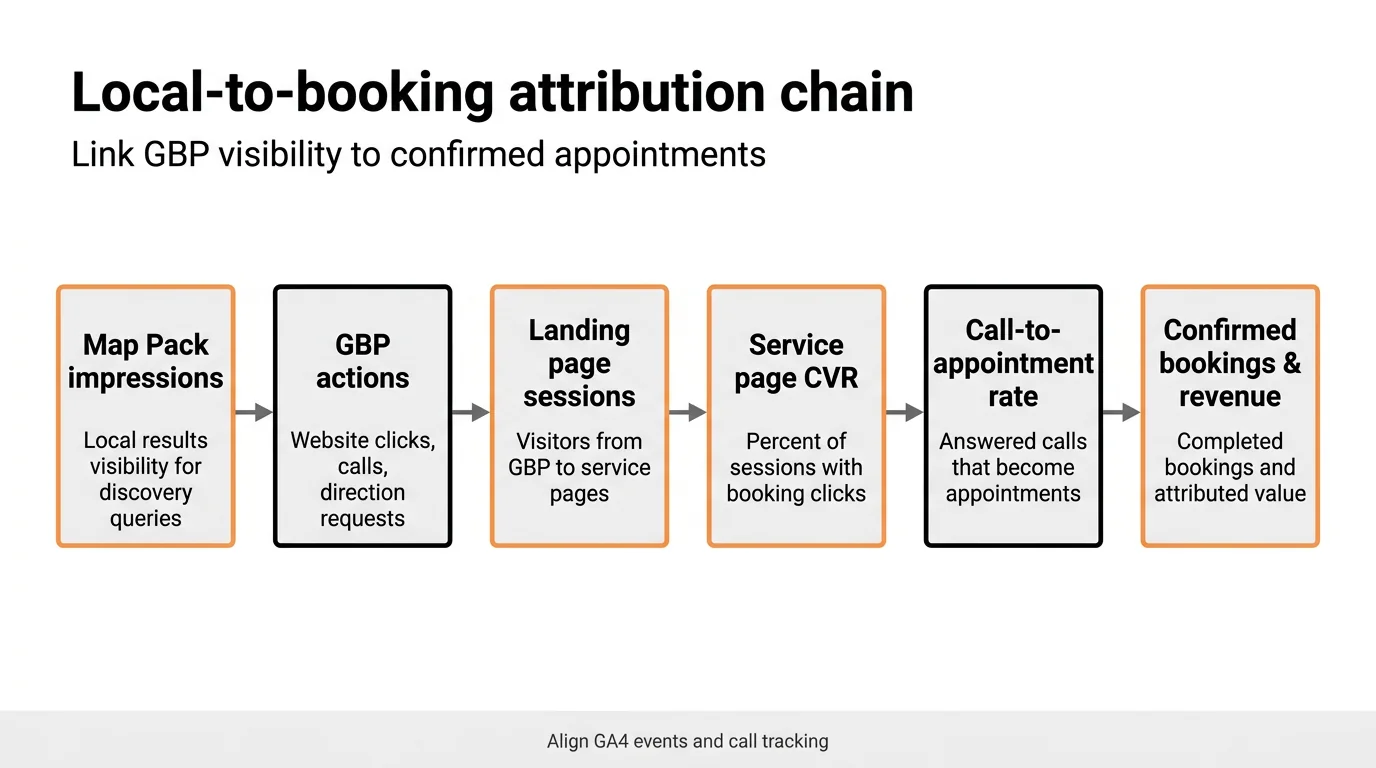
We link Map Pack impressions to direction requests and calls, then to service page conversion rate and call-to-appointment rate. This chain supports attribution across channels, while acknowledging SEO measurement limits.[3]
Petbase automates SEO content for pet stores - publishing 10 optimized articles monthly so you can focus on running your shop - start your free trial.
Define your KPI stack for a grooming shop
Visibility KPIs: Map Pack impressions, discovery vs branded
Track Map Pack impressions to quantify local visibility. Separate discovery searches from branded searches to understand reach versus recall. Rising discovery aligns with findability; branded increases often reflect reputation effects.
Engagement KPIs: clicks, direction requests, calls, website visits
Measure click-through from the Map Pack, direction requests tracking, and call clicks from Google Business Profile. Combine with landing sessions to gauge engagement quality. Watch weekday and hour patterns for staffing alignment.
Conversion KPIs: service page CVR, booking rate, call-to-appointment rate
Use service page conversion rate to capture session-to-booking efficiency. Benchmark by service type and device. For page enhancements that improve intent match and speed, review High-Intent Grooming Service Pages: From Dog Bath to Full Groom.
Revenue KPIs: average ticket, new vs returning client mix
Track revenue per appointment and the ratio of new versus returning clients. Pair with service mix to see margin contributions. Revenue KPIs contextualize volume metrics and guard against low-value bookings.
Set up accurate attribution without guesswork
UTM naming: a clean, reusable convention
Adopt consistent UTMs for all links you control. Example: utm_source=google, utm_medium=organic, utm_campaign=gmb, utm_content=book_button. Consistency reduces fragmented reporting and improves cross-tool comparability.[4]
Call tracking: dynamic numbers and source mapping
Use dynamic number insertion to show different tracking numbers by source. Configure source-level and landing-page pools. For call tracking for groomers, map sessions with UTMs to call sessions and answered status.
Booking software events: source/medium and service captured
Pass UTM parameters into your booking system and store them with appointment records. Capture service type, staff, and price. This linkage enables channel-level booking and revenue attribution with fewer assumptions.
Google Business Profile: call click, direction, and website visit linkage
Enable tracking for website clicks, call clicks, and direction requests in GBP. Compare GBP actions with landing page sessions and calls. For setup details, see Google Business Profile for Groomers: Map Pack Setup and Optimization.
Implement goals and events step-by-step
GA4 events and conversions for grooming services
Define events such as view_service, book_click, book_submit, and book_confirmed. Add parameters for service_name, service_id, price, and source. Mark book_confirmed as a conversion to standardize across pages and devices.[1]
Thank-you page and server-side validation options
Prefer a unique confirmation URL for book_confirmed to prevent duplicates. If not possible, use server-side tagging to fire events only after payment or appointment creation. This may improve accuracy under consent constraints.
Phone call goals: click-to-call vs answered calls
Separate click-to-call events from answered-call completions. Feed answered status from your call tracking tool into GA4 via Measurement Protocol. Use this to calculate call-to-appointment rate by marketing channel.
Quick decisions: if X happens, do Y
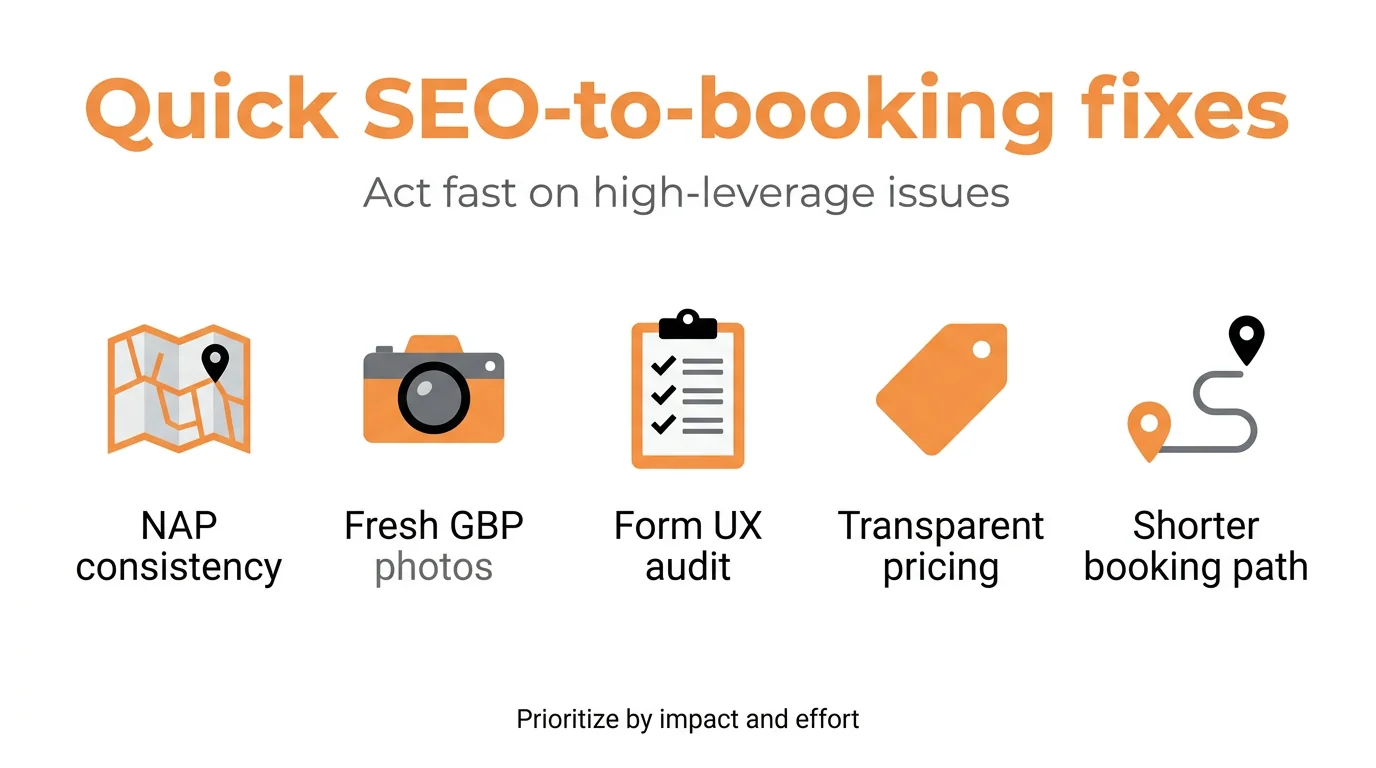
If Map Pack drops more than 20% in 14 days, refresh NAP, categories, and photos; review recent reviews
Verify name, address, and phone consistency and correct primary category. Add fresh photos and check hours. If NAP issues exist, prioritize directory fixes using Citations and NAP Consistency for Groomers: Directories that Move the Needle.
If direction requests rise but bookings do not, improve form UX and price clarity
Audit form steps, autofill, and error states. Surface transparent pricing and inclusions near the form. Test a shorter booking path and clear confirmation messaging to reduce uncertainty-driven abandonment.
If bath/groom service page CVR is below 2%, test sticky buttons and above-the-fold social proof
Add a persistent “Book Now” button, speed up load, and place review snippets high. Address top anxieties with FAQs. Compare against best practices in Grooming Pricing Pages that Convert: Transparent Tiers and Booking Prompts.
If calls increase but appointments do not, adjust hours, IVR, and scripting to capture details
Expand answer coverage during peaks. Simplify IVR, and train staff to capture name, pet details, and service intent quickly. Offer call-back and SMS confirmation to reduce drop-off.
If organic traffic rises without revenue, audit UTM tags and duplicate GA4 events
Inspect URL parameters for typos fragmenting sessions. Check that book_confirmed fires once per booking. Remove duplicate tag containers. Align channel groupings to ensure organic sessions are not misclassified.
If reviews are under 4.3 stars, prioritize reputation before scaling content
Reputation influences both Map Pack rank and conversion. Implement a request-and-response workflow. Address recurring service issues and close the loop. Strengthening social proof may lift conversion across channels.
If a breed or service leads revenue, build a specific page and link it internally
Create a focused landing page addressing that service’s needs and objections. Link it from navigation and related pages. Internal linking may distribute authority and lift relevancy for adjacent terms.
Monitoring: what to watch at 7-14 days and 4-8 weeks
7-14 days: data integrity and early signals
Confirm UTMs are consistent and events fire once. Validate call tracking matches session sources. Compare Map Pack impressions and direction requests against past periods for anomalies and initial trend direction.
4-8 weeks: conversion trends and profitability by channel
Evaluate service page conversion rate by device and channel. Compare call-to-appointment rates and show rates. Attribute revenue per booking and customer lifetime indicators. Prioritize channels showing sustained, efficient acquisition.
Practical limits and safety margins
Healthy CVR ranges and no-show rates
For grooming services, 2-5% session-to-booking may be a reasonable starting range. Call-to-appointment rates often vary widely. Monitor no-shows closely; a modest buffer may protect schedules without reducing throughput.
Operational capacity and hours to avoid overbooking
Align booking slots with staff capacity and turnaround times. Stagger start times to reduce bottlenecks. Use blackout rules and lead-time constraints to prevent overselling peak windows and straining service quality.
Privacy and compliance in call tracking
Announce call recording where required. Limit data captured in notes, and secure access rights. Retain recordings only as necessary. Respect consent preferences when passing identifiers between analytics and booking systems.
State of the evidence and cautions
What GBP and GA4 data suggest
Evidence indicates that aligning analytics with defined KPIs improves interpretation and actionability across channels.[1] Studies in service sectors emphasize that structured SEO metrics and analytics are essential for assessing outcomes and guiding investment decisions.[2]
Where attribution may bias and how to mitigate
Last-click models may undervalue discovery and navigational touchpoints.[3] Combine GBP actions, GA4 assisted conversions, and call outcomes for balance. Maintain consistent UTM governance to reduce fragmentation and improve cross-channel comparisons.[4]
Templates and KPI examples for grooming
Minimum viable dashboard
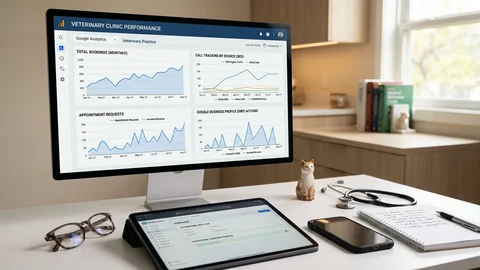
Columns to include: Map Pack impressions, GBP clicks, direction requests, calls answered, website sessions, service page conversion rate, bookings, call-to-appointment rate, revenue, and average ticket. Segment by channel, device, and service type for clarity.
Monthly target example and how to read results
Target: 120 bookings, 30% new clients, $85 average ticket. If discovery impressions rise 25% and direction requests climb, but service page CVR lags, prioritize messaging and speed before expanding content or campaigns.
Frequently Asked Questions
Which SEO KPIs best predict grooming bookings?
Evidence suggests Map Pack impressions, direction requests, service page conversion rate, and call-to-appointment rate are most indicative. Track them alongside revenue per booking for context.
How do I attribute phone bookings to SEO traffic?
Use dynamic call tracking with source-level numbers and pass UTM parameters. Reconcile answered-call logs with booking records to estimate call-to-appointment rate by channel.
What is a good conversion rate for a grooming service page?
Benchmarks vary, but 2-5% session-to-booking may be a reasonable starting range. Monitor 4-8 weeks and iterate on messaging, proof, and forms to improve.
How should I structure UTMs for local SEO links?
A simple convention may help: utm_source=google, utm_medium=organic, utm_campaign=gmb, utm_content=book_button. Keep names consistent to avoid fragmented reporting.
Do direction requests correlate with revenue?
They may indicate high local intent. Pair direction trends with bookings in the same period; rising directions without bookings can signal friction on-site or scheduling.
Next step: align KPIs with your complete strategy
Connect this system with service and local content
Translate insights into targeted pages, improved pricing communication, and structured internal links. For sustained content execution, many teams use tools like Petbase AI to maintain topical coverage and testing velocity.
Consult the master grooming SEO guide for coherence
Ensure your KPI stack, attribution setup, and content roadmap move in the same direction. Reference the master grooming SEO guide to align local visibility, on-site experience, and booking operations into one system.
References
- IC Drivas et al. (2020). Big data analytics for search engine optimization. Big Data and Cognitive …. View article
- CO Altin et al. (2023). The effectiveness of search engine optimization practices in promoting Turkey's tourism destinations. A case study of tourism destinations in Istanbul city. … of Hospitality and …. View article
- F Almukhtar et al. (2021). Search engine optimization: a review. Applied computer …. View article
- SS Aman et al. (2024). Search engine Performance optimization: methods and techniques. F1000Research. View article